class: center, middle, inverse, title-slide # Econ 330: Urban Economics ## Lecture 13 ### Andrew Dickinson ### 10 August, 2021 --- class: inverse, center, middle # Lecture 14: Automobiles --- class: inverse, middle # Schedule .pull-left[ .ul[.bigger[.hi-gold[Today:]]] .hi-white[(i). US automobile use] .hi-white[(ii). Externalities] .hi-white[(iii). Congestion Pricing] ] -- .pull-right[ .ul[.bigger[.hi-gold[Upcoming:]]] - .hi-white[Reading:] (Chapter 8) - .hi-white[Book Report:] Due August 15 - .hi-white[PS02:] Due August 15 ] --- # Automobile use data --- # Auto use in the US .pull-left[ 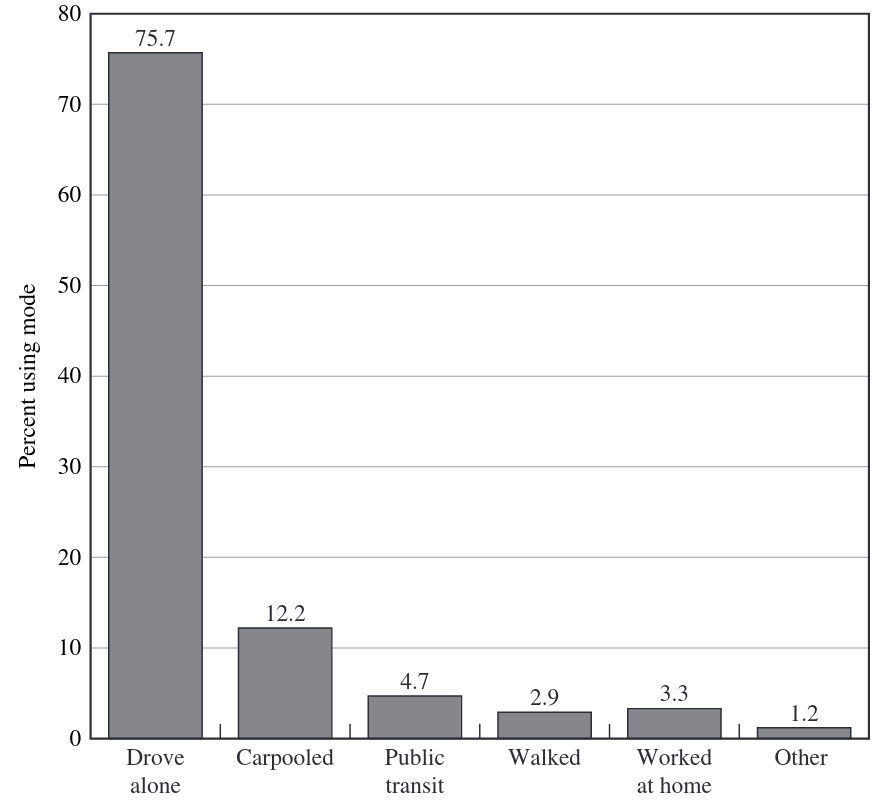 ] -- .pull-right[ .hi[Facts about American auto use:] - 88 percent of commuters use the car - Only 5 percent of commuters use public transit at the national level - Only 2 metro areas have public transit use above 10 percent - NYC - Chicago] --- # Vehicle Miles Traveled <iframe src="https://fred.stlouisfed.org/graph/graph-landing.php?g=FW1b&width=800&height=475" scrolling="no" frameborder="0" style="overflow:hidden; "target=_self"; width:800px; height:525px;" allowTransparency="true" loading="lazy"></iframe> --- # US: People like Cars <iframe src="https://ourworldindata.org/grapher/road-vehicles-per-1000-inhabitants-vs-gdp-per-capita" loading="lazy" style="width: 100%; height: 500px; "target=_self"; border: 0px none;"></iframe> --- # Carbon Emissions <iframe src="https://ourworldindata.org/grapher/road-vehicles-per-1000-inhabitants-vs-gdp-per-capita" loading="lazy" style="width: 100%; "target=_self"; height: 500px; border: 0px none;"></iframe> --- # Climate crisis A recent [UN scientific report](https://www.ipcc.ch/report/ar6/wg1/#SPM) leaves no doubt that humans are responsible for the current climate crisis -- Increased frequency of extreme weather including: .pull-left[ - Wildfires - Winter storms - Hurricanes] .pull-right[ - Heat waves - Floods - Droughts ] -- Other consequences include: .pull-left[ - Mass extinctions - Changes in ocean currents] .pull-right[ - Loss of habitat (reefs, rainforest, ice sheets) - Sea level rise ] --- # Climate crisis 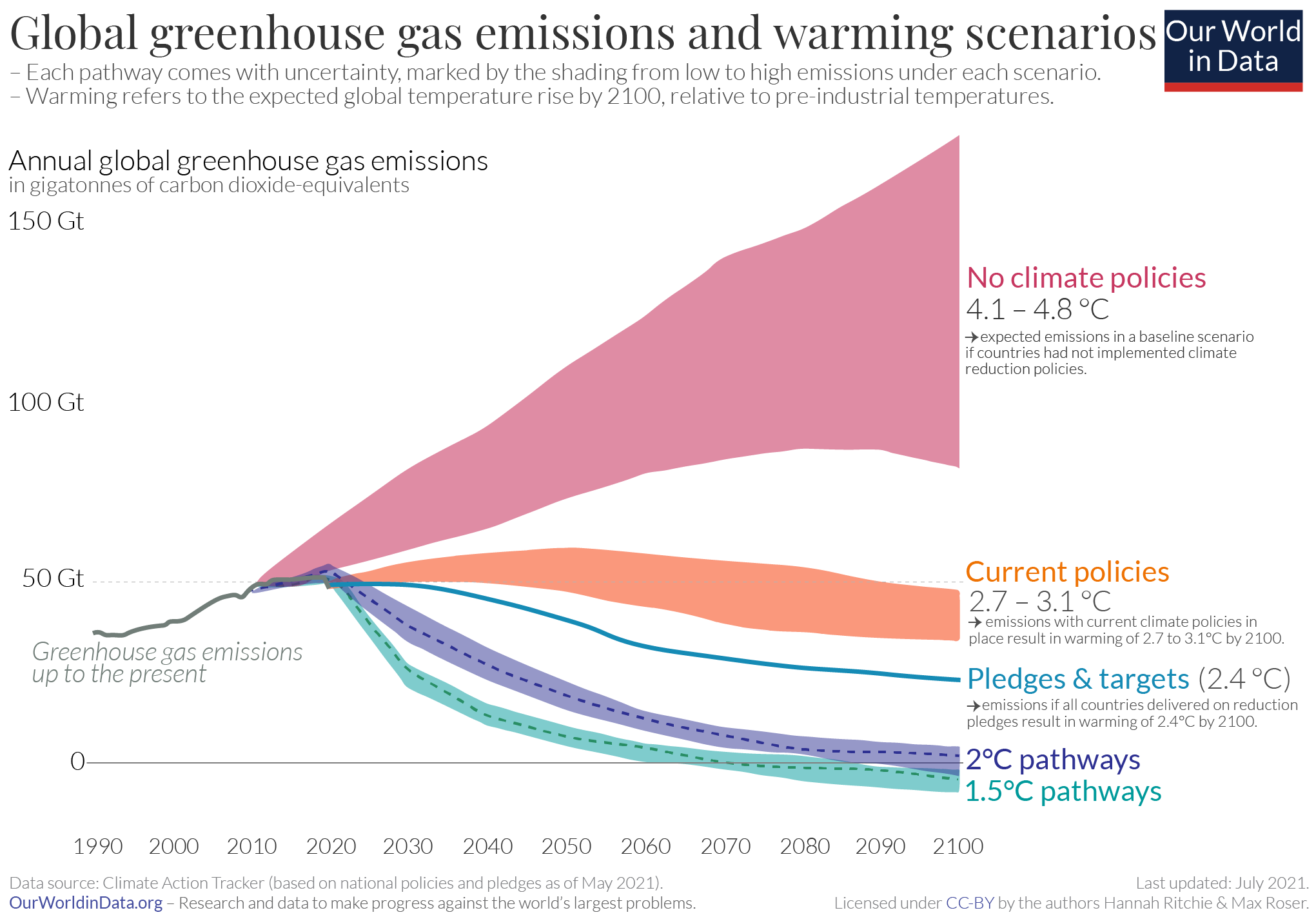 --- # Carbon emissions <iframe src="https://ourworldindata.org/grapher/co-emissions-per-capita?tab=chart&country=USA~BRA~Europe+%28excl.+EU-27%29~IND~RUS~CHN~JPN" loading="lazy" style="width: 100%; "target=_self"; height: 500px; border: 0px none;"></iframe> --- # Carbon emissions <iframe src="https://ourworldindata.org/grapher/annual-co2-emissions-per-country?tab=chart&country=USA~CHN~EU-28~IND~RUS~JPN~BRA" loading="lazy" style="width: 100%; height: 500px; "target=_self"; border: 0px none;"></iframe> --- # Policy questions -- .center[.hi[Currently per capita CO2 emissions in develping countries skyrocket?]] -- .center[.hii[The future of global carbon emissions depends heavily on how car ownership rates evolve in China and other emerging economies]] -- <br> .center[.hi[How do we reduce CO2 per capita emissions?]] -- .center[.hii[What axiom can we apply to improve our understanding of usage?]] -- .center[.hi[Do drivers fully internalize the costs of CO2 emissions?]] --- class: inverse, middle # Externalities --- # Externalities .hi[Recall Axoim 3:] .hii[Externalities cause inefficiency] -- What are some externalities from driving? -- .pull-left[ - Congestion - Environmental Damage - Collisions] .pull-right[ - Blight (parking lots instead of parks) - Noise Pollution] -- .hi[How costly is congestion?] Typical commuter spends .hi[47 hours per year] in traffic - Very high in some metro areas (LA: 93, SF: 72, Atlanta: 67) - Estimated gasoline cost due to congestion delays: .hi[5 billion per year] - Time + Gas cost estimate: .hi[63 billion per year] --- # Externalities -- .smallerer[ .hi[.ul[Definition:] Marginal Social Cost] (MSC) > Added cost to _society_ from one extra unit of production/consumption .hi[Note:] `\(MSC \neq MC\)` ] -- .smallerer[.hi[.ul[Definition:] Marginal Private Cost] (MPC) > Added cost to _agent_ from one extra unit of production/consumption .hi[MSC is the marginal cost (private) plus the marginal external cost (social)] ] -- .smallerer[ .hi[.ul[Definition:] Marginal Social Benefit] (MSB) > Added benefit to _society_ from one extra unit of production ] -- .smallerer[ .hi[.ul[Definition:] Marginal Private Benefit] (MPB) 19 / 34 > Added benefit to _society_ from one extra unit of production ] --- # Externalities: Example Consider the market for .hi[gasoline] -- Using gasoline in cars causes air pollution and generates greenhouse gases -- Gasoline producers pays its input suppliers and workers but does not consider the external costs to society - MSC > MPC --- # Congestion externalities Let's start by assuming the only externality from driving is congestion .hi[Consider a commute within a metro area with the following characteristics:] - Distance ( `\(d\)` ): Let the commute distance be 10 miles `\(d = 10\)` - Monetary travel cost ( `\(m\)` ): Monetary costs are \$0.2 per mile `\(m = 0.2\)` - Time cost ( `\(c\)` ): Opportunity cost of time is \$0.1 per minute `\(c = 0.1\)` -- Thus the total cost of the trip is `\((m + c)\cdot 10\)` --- # Congestion externalities .center[ 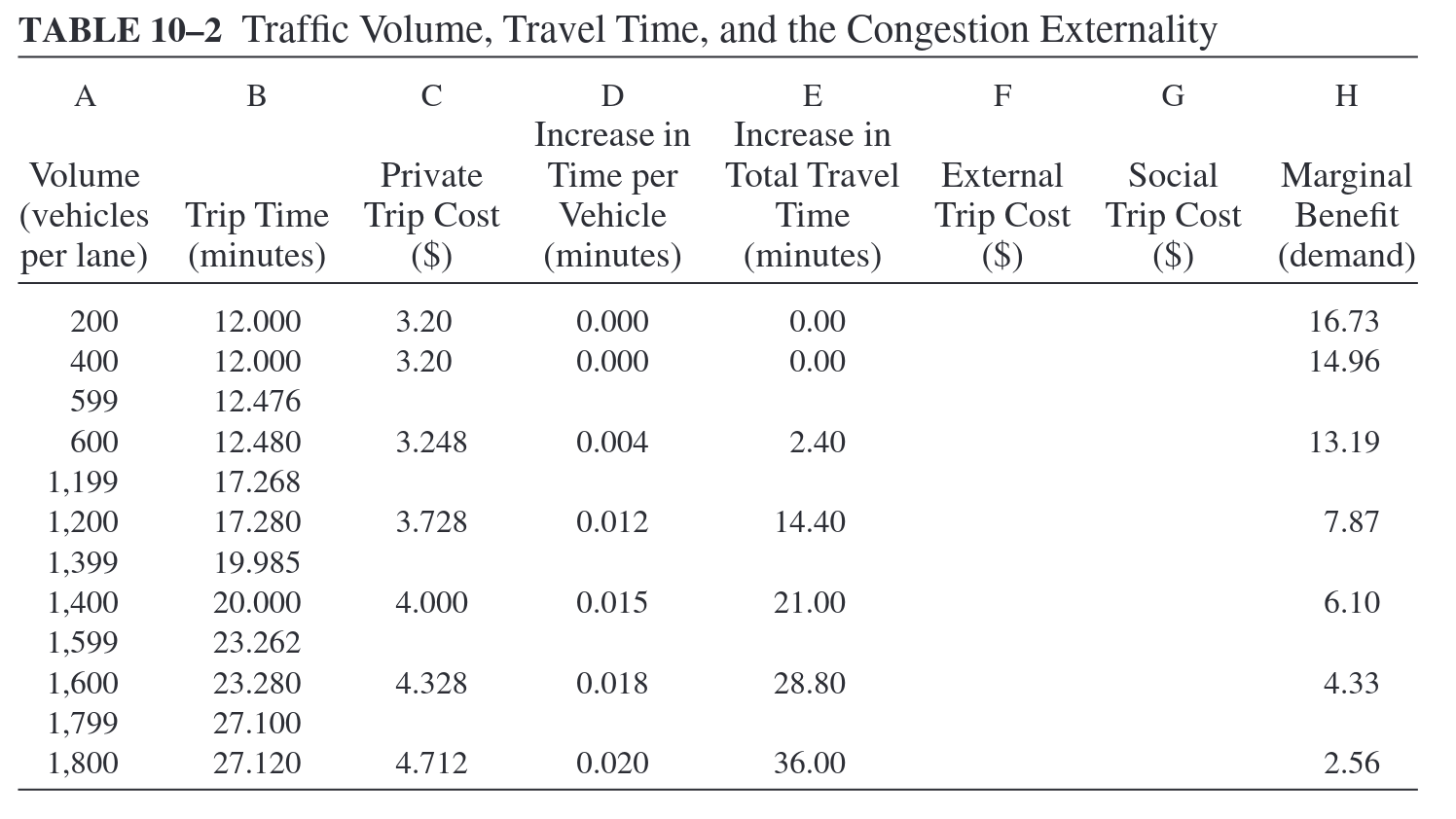 ] --- # Congestion externalities -- .center[ 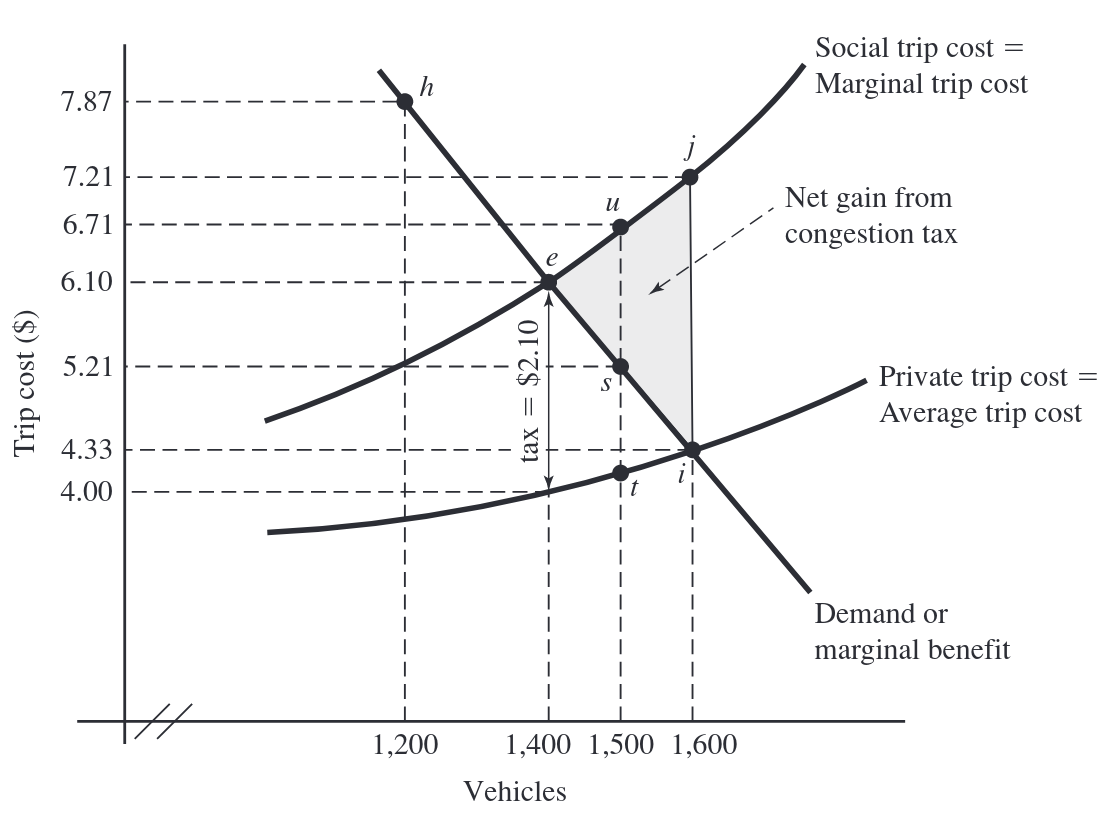 ] --- class: inverse, middle # Congestion pricing --- # Congestion pricing How do we fix .hi[Congestion?] -- .hii[Popular Answer:] Build more roads -- Building more roads `\(\Rightarrow\)` more space for cars `\(\Rightarrow\)` congestion will decrease -- .qa[Q]: What assumption must we make when stating .center["_building roads will reduce congestion_"] -- .qa[A]: The number of drivers will remain the same after the road is built -- .hi[Is this true?] --- # My nightmare: LA Traffic  --- # Congestion pricing: Cost incentives Obvious when we think about the incentives of drivers -- .hi[(i).] People avoid driving because it is costly - Time cost - Gas cost - Matinence cost -- .hi[(ii).] Building a new road makes it less costly - Time cost `\(\downarrow\)` -- .hi[(iii).] On the .hi[margin], people will start to drive when the new road is built --- # Tangent: How do traffic jams start? What actually causes congestion/traffic? -- <center> <iframe width="560" height="315" src="https://www.youtube.com/embed/7wm-pZp_mi0" title="YouTube video player" frameborder="0" allow="accelerometer; autoplay; clipboard-write; encrypted-media; gyroscope; picture-in-picture" allowfullscreen></iframe> </center> [Overbreaking](https://youtu.be/iHzzSao6ypE) --- # Externalities: Pigouvian taxes Roads: Not a great solution. Better idea? -- No more monkies driving on the roads? Tech isnt there yet. -- .center[.hi[Pigouvian taxes]] -- .hi[Main insight:] The social cost of driving exceeds private cost So how can we raise the MPC such that `\(MPC = MSC\)` -- .center[.hi[How can we do this?] .hii[Tax them.]] -- The pigouvian tax specific to reducing road congestion is .hi[congestion pricing] --- # Externalities: Pigouvian taxes Many cities across the globe have enacted or are planning to enact congestion pricing .pull-left[ - London - Singapore - Milan] .pull-right[ - Stockholm - Bejing - NYC, LA, SF (coming soon) ] -- .hi[Results:] Following enactment of congestion pricing in London: - Traffic was reduced by 15% - Reduced travel times in the city by 30% --- # Congestion pricing: London .center[  ] --- # Congestion pricing: London .center[  ] --- # Congestion pricing: London .center[  ] --- # Model with Pigouvian Taxes --- # Peak vs. Off Period Taxes --- # Mechanisms Model demonstrated congestion taxes reduce traffic volume. How? -- .hi[(i).] Modal substition: switch to carpool, public transit -- .hi[(ii).] Switch to off-peak travel -- .hi[(ii).] Switch route -- .hi[(iv).] Location decisions: change residence or workplace --- # Discussion Congestion taxes sound like a good idea, right? What are the problems? -- - Roads aren't always congested. So tax needs to be time-varying. Gets very complicated - Are all autos charged the same amount (semis and prius?) -- How can this idea be adapted to combat the .hi[climate crisis?] -- .center[.hii[Put a tax on carbon]]