Methodological Guidelines for The Mozart Expositional Punctuation Corpus: A Dataset of Interthematic Cadences in Mozart’s Sonata-Allegro Expositions
Uri B. Rom, Omer Raz, and Dror Chawin
The Buchmann-Mehta School of Music, Tel Aviv University, Tel Aviv, Israel
The following guidelines are divided into four sections documenting different aspects of our decision making process in labeling interthematic cadences. In the first section, we discuss the requirements for recognizing a given musical event as a cadence. In the following two sections we discuss criteria for labeling expositional closural events as interthematic cadences: in section 2 we address considerations that pertain to all four closural types used in our annotations; in section 3 we discuss specific closural types, that is, K1, K2, K3, and K4. Finally, in section 4 we include additional methodological considerations regarding miscellaneous aspects of our decision making, repertoire selection, and annotation standard.
1. Methodological guidelines for the identification of cadences
Cadences are closural events punctuating the musical fabric and, thus, segmenting a musical piece into smaller units. Cadence identification and analysis in general represent highly topical research fields at the junction between Formenlehre (e.g., Rosen, 1988; Caplin, 1998, 2004; Webster, 2001; Hepokoski and Darcy, 2006), contextualized harmonic analysis (e.g., Caplin, 2004; Rohrmeier and Neuwirth, 2015; Martin and Pedneault-Deslauriers, 2015), schema theory (e.g., Temperley, 2004; Gjerdingen, 2007), and computational and empirical musicology (e.g., Ito, 2014; van Kranenburg and Karsdorp, 2014; Duane, 2019). The phenomenological complexity of cadences, and the difficulty of identifying and classifying cadential events have been amply pointed out in recent research literature (see, e.g., the monographic collection of studies on the Classical cadence in Neuwirth and Bergé, 2015). Cadences are required to fulfil certain intrinsic (local) and extrinsic (contextual) requirements in order to be recognized as such. The current section discusses the intrinsic preliminaries of cadences (or, in some rare cases, surrogate harmonic progressions) that are labeled in our corpus—cadences’ contextual preliminaries will be discussed in the following sections.
Intrinsically, a closural event is articulated by means of a certain voice-leading/harmonic progression that sufficiently establishes the harmonic degree embodied by the closure’s type. In the case of the four expositional closure types specified by Heinrich Christoph Koch (1782–1793, vol. 3, pp. 342ff.), cadences establish the principal-key and secondary-key tonic in K1 and K4-type authentic cadences respectively, and the principal-key and secondary-key dominant in K2- and K3-type half cadences respectively. Accordingly, the two relevant cadence types for our considerations are the authentic (both perfect and imperfect) and the half cadence. Deceptive cadences, representing authentic cadential progressions in which the expected final tonic degree is replaced by a tonic substitute, do not qualify as K1-/K4-type cadences and are disregarded in our labeling (in this, we succumb to the traditional definition of deceptive cadences rather than the more recent one proposed by Neuwirth [2015]—the author proposes to conceive of specific forms of imperfect authentic cadences in terms of “melodic deceptiveness”).
The evaded cadence—more a cadential strategy than a specific cadence type—stands for aborting the cadential process short of its cadential goal, or, alternatively, attaining the cadential goal in a deficient form. As far as the expected, standard harmonic degree is substituted for by an alternative degree, evaded cadences (similarly to deceptive ones) do not qualify for inclusion under the four cadential labels used in our annotations. However, we take into account certain evaded cadences in which the correct degree is attained, but is articulated through a deficient voice leading as discussed below.
Caplin (2004) distinguishes several crucial components in the preparation and execution of a cadence, whether an authentic or a half cadence. The obligatory components he specifies are cadential function (p. 56), that is, the time-span that contains the cadential progression culminating in the cadential arrival, and the cadential arrival itself, the goal of the cadential progression and the point at which the cadential degree is attained (the tonic in the case of an authentic cadence, the dominant in the case of a half cadence). Caplin’s postcadential function embraces the time-span between the cadential arrival and the subsequent new beginning and serves to prolong (or re-establish) the cadential degree. (He distinguishes [p. 90] between codettas which constitute a typical extension of authentic cadences, in particular toward the end of an exposition/recapitulation, and standing on the dominant which is a typical prolongational strategy of half-cadences.) He further argues (p. 97f.) that a cessation of activity (a rest) is neither obligatory nor necessarily indicative of a cadence. (Notably, Caplin’s cadence concept is more narrowly defined than our concept of interthematic closure in the present corpus project.)
Based on Caplin’s discussion, we distinguish the following stages in a closural event’s trajectory (see. Figure G1):
Cadential preparation: the time-span throughout which a cadential arrival is prepared via a cadential progression.
Cadential arrival: the goal of the cadential preparation; at this temporal position the music expresses the closural degree.
Postcadential space: an optional component, omitted when the cadential arrival is directly elided with the new beginning. Since we conceive of the cadential arrivals as an instantaneous event, the postcadential space (if extant) is considered to begin directly at the point of arrival. It consists of one or more of the following optional components in the prescribed order:
- Postcadential extension – prolonging or re-establishing the closural degree.
- Caesura – a temporary cessation of melodic and harmonic activity, most typically a short rest in all voices.
- Postcadential link – a passage linking the cadential arrival or any component of the postcadential space with the beginning of the next unit.
New beginning: the temporal position (often a downbeat) at which the next musical unit is considered to start. Although the new beginning is not anymore part of the closural event, it is considered to delineate it.
Note that our annotations contain information only regarding the temporal positions of the cadential arrival (columns <cad_ arr_m.> and <arr_ beat> in our dataset) and the new beginning, which latter we construe to demarcate the end of the postcadential space (<end_ m.> and <end_ beat>).
Figure G1: A closural event’s trajectory

A few remarks concerning the trajectory depicted in Figure G1:
· Although every closural event requires cadential preparation, annotations regarding the time-span preceding the cadential arrival and the cadential progression it contains go beyond the scope of the present annotation project. We point to the fundamental methodological difficulty to determine the temporal position at which preparing a given cadence commences—obviously, the ambiguity of the preparation time-span also implies ambiguity of the cadential progression’s content. We consider a research into Mozart’s cadential preparations to constitute a separate annotation project that may be based on the present one and complement it. (Note that we also refrain from including detailed information regarding the closural degree itself—although this degree can be inferred from Table 1 in our main report, in certain cases the actual closural sonority is a variant of the one specified in the table, e.g. as a result of inversion or—in the half-cadential types—through an added seventh.)
· The cadential arrival consists of attaining the cadential degree: the main-key tonic in the case of K1-type cadences, the main-key and secondary-key dominant in the case of K2- and K3-type half cadences respectively, and a (sufficiently established) secondary-key tonic in the case of K4-type cadences. As discussed above, we also allow for certain constellations in which these degrees occur in a deficient form. In case that the arrival of the cadential degree is reiterated several times using identical (or near-identical) voice leading, we select the most recent instance as the point of cadential arrival (see, e.g., K. 183/iv, mm. 17–24 in Example G7 below: of the two near-identical arrivals on the secondary-key dominant, we opt for the later one in m. 24 as the point of cadential arrival). By contrast, any subsequent progressions that prolong or re-establish the cadential degree using a different voice-leading pattern are as a rule assigned to the postcadential space and construed as postcadential extensions. (Importantly, hypermetrical and textural considerations also play a role in determining the point of arrival among multiple competing options—e.g., in the fourth movement of Eine kleine Nachtmusik K. 525 the main-key dominant is already attained at m. 14 via a passage in the unison; however, we select the next measure, m. 15, as the point of half-cadential arrival, as the dominant degree is there re-established as a full triad.)
· We define direct elision as a constellation in which the cadential arrival is directly elided with the beginning of the following new section. In such cases, the postcadential space has a size of zero. (As discussed above, the postcadential space as well as each of its constituents are optional—in the case of direct elision it is omitted altogether.) Consider, for instance, the first movement of the Sonata for Two Pianos in D major K. 448: the cadential arrival of the type K1 on the downbeat of m. 17 is directly elided with the beginning of the transition section allowing no space for postcadential activity (see discussion and Figure 1 in our main report).
· In case that the postcadential space has a non-zero size, we construe any lengthening of the closural degree beyond the point of arrival as a postcadential extension, even if it merely consists of the duration of a single sonority, that is, the closural degree itself. Note that besides its size, our annotations contain no additional information regarding the structure of the postcadential space, which may consist of a postcadential extension, a caesura, and a postcadential link (in this order).
· In case there is no direct elision at the point of arrival, we construe the normal minimal size of the postcadential space, stretching between the cadential arrival and the new beginning, to be one measure in common time (4/4), alla breve (2/2), 3/4, 6/8 and 12/8 time. In 2/4 and 3/8 time, we allow for two measures. We consider any size above these values to represent an augmented postcadential space (see summary statistics in our main report). Notably, this is a rough approximation, as the question of whether a given postcadential space is actually perceived as augmented depends on many additional factors (e.g., the movement’s tempo, the degree of rhythmic and textural complexity, the exact metrical position of the cadential arrival and the subsequent new beginning, etc.).
· In addition to direct elision at the point of cadential arrival, we define indirect elision as a constellation in which the end of the postcadential extension is elided with the new beginning, as in the case of the K3-type closure in first movement of the Sonata for Two Pianos K. 448 at m. 30 (see discussion and Figure 1 in our main report). Obviously, in such cases (as opposed to direct elisions), the timestamps of the closural event’s beginning and end differ (see summary statistics in our main report).
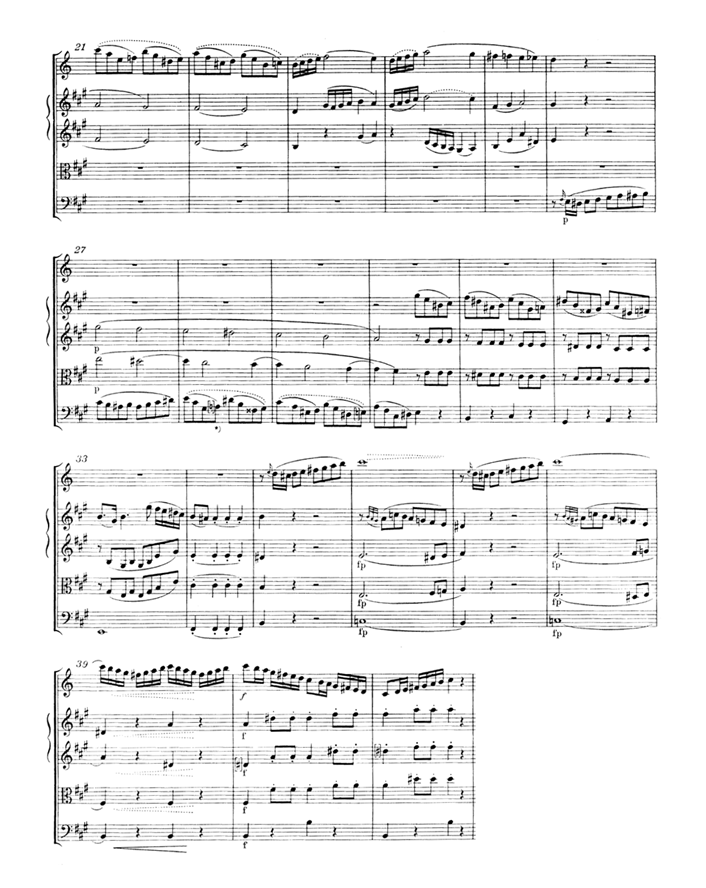
· Although postcadential extensions prolong the closural degree across the postcadential space (or, at least, some of it), they may involve some (minor) variation of the closural degree between the point of arrival and the extension’s end. For example, the K3-type closure attained as a dominant triad at m. 35 in K. 581/i (see Example G1 below) is turned into a dominant seventh chord in the course of the postcadential extension (mm. 35–41); in K. 132/i (Example G6 below), the K2-type closure attained at m. 22 as a first-inversion dominant is subsequently transformed into a root-position dominant. Such variants occasionally occur also in conjunction with indirect elisions: in K. 448/i, a K3-type closure attained at m. 25 with the chord’s root in the upper voice is re-established in the course of the postcadential extension, but this time with the third in the upper voice (at the downbeat of m. 30), at which point it is elided with a new beginning (see discussion and Figure 1 in our main report).
· Caesuras, construed as a temporary cessation of rhythmic, melodic and harmonic activity, represent an optional component of the postcadential space. We argue that the sense of caesura doesn’t necessarily depend on the existence of simultaneously notated rests in all parts: for instance, in the first movement of the Dissonance Quartet K. 465/i (see Example G5 below), following a K4-type cadential arrival on the downbeat of m. 71 there is a perceived caesura between the octave leap in the cello and the upbeat figure in the violins starting on the third beat of the measure (interpreters may take additional time between beats 2 and 3). On the other hand, not every rest in the postcadential space qualifies as a caesura: in the finale of the Symphony in G minor, K. 183 (see Example G7 below), the rest in m. 25 occurs in the middle of the postcadential extension of the half cadence attained one measure earlier, whereas the rest in the following m. 26 constitutes a veritable caesura separating the postcadential extension from a link leading to the new beginning at m. 28.
· We define postcadential links as passages that connect the postcadential space with the subsequent new beginning. Postcadential links are mostly short (often below one measure), one-voice melodic figures. Typically, they represent non-thematic, scalar or scale-derived melodic connectors (as in the case of the string-section unison figure in K. 183/iv, mm. 26–27, see Example G7). Occasionally, a link may also have some thematic standing of its own (consider, for instance, the postcadential link in K. 183/iv, mm. 37–40, which quotes the movement’s primary theme using a subtle imitation between the two violin parts—notwithstanding this passage’s polyphonic sophistication and its quasi-independent thematic substance, we construe it as a mere link to the following unit’s beginning at m. 41). We further construe as links short upbeat figures that already pertain to the subsequent thematic presentations (as, e.g., the two-voiced upbeat figure in the violin parts in 465/i, m. 71, see Example G5); on the other hand, thematic upbeats of one measure or longer are construed as part of the following unit and do not count toward enhancing the postcadential space (consider, e.g., the one-and-a-half measure upbeat to the secondary theme in the first movement of the Symphony K. 338, mm. 40–41). The onset of a new theme’s accompaniment is invariably assigned to the new thematic presentation (rather than the preceding postcadential space), even where the theme’s melody joins only later (for example, the one-measure oscillating accompaniment figure introducing the secondary theme in the first movement of the Sonata facile K. 545 is construed as part of the theme, see Example G5, m. 13).
· Postcadential links are elided at least on one side—in particular, the link’s end is always elided with the subsequent new beginning. However, given that a link’s goal (as opposed to a postcadential extension’s) is not to reiterate the closural degree, but rather to lead into the new section (which often begins on a different harmonic degree, especially after a K3-type cadence), we argue that such elisions do not pertain to the closural event proper. Additionally, a postcadential link’s beginning may also be elided with the preceding cadential arrival, or, alternatively, with the end of its postcadential extension (see detailed discussion of postcadential links in conjunction with K3-type half cadences below). Ultimately, as we conceive of postcadential links not in terms of musical passages in their own right, but rather as filling in an imaginary postcadential caesura connecting the postcadential space to the following new beginning, we keep no track of elisions involving postcadential links in our annotations.
Authentic cadences
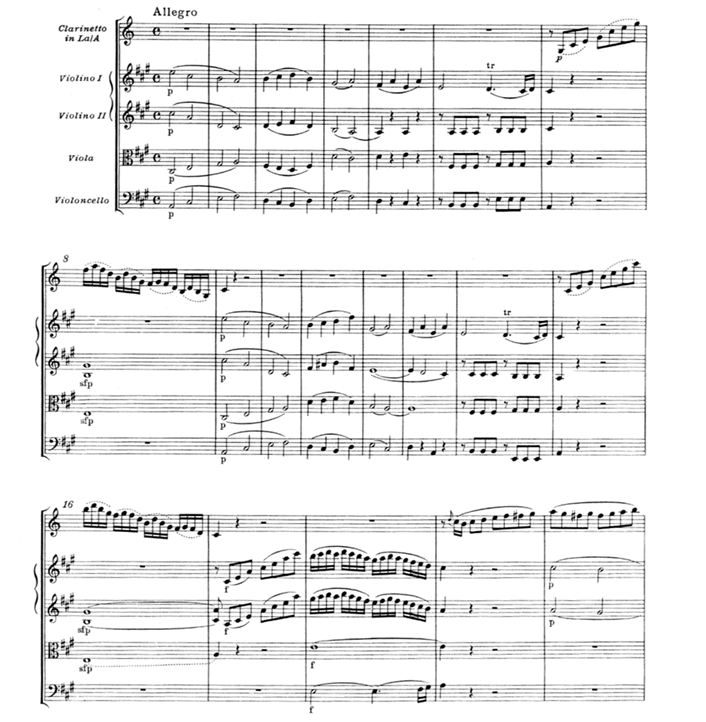
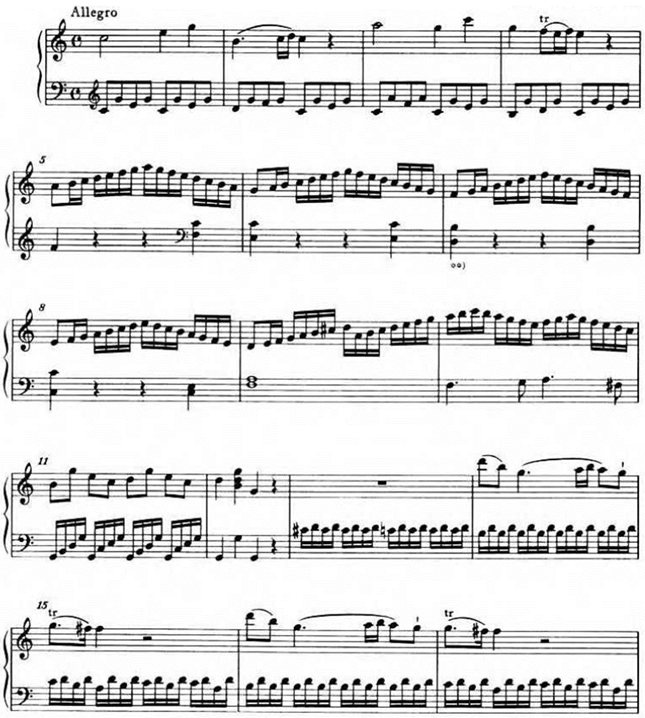
Modern theories of harmony (cf., e.g., Aldwell, Schachter, and Cadwallader, 2011; Kostka, Payne, and Almén, 2013) distinguish between two types of authentic cadences: the perfect authentic cadence ending on the tonic with the root in the upper voice (in addition to the bass), and the imperfect authentic cadence that has another scale degree of the tonic chord (the third or the fifth) in the upper voice. As a rule, K1 and K4-type cadences are perfect (see, e.g., Figure 1 in our main report, mm. 17 and 33 respectively); however, occasionally an imperfect authentic cadence may fulfill an interthematic function: for instance, in the first movement of Mozart’s Clarinet Quintet K. 581 (see Example G1) the opening theme attains several imperfect cadences on the tonic with the third scale degree in the upper voice, of which we label the one at m. 15 as “K1.” The strength of a given authentic cadence also depends on the inversion of the preceding dominant: the cadential progression in the first movement of the Sonata facile K. 545, at m. 4 (see Example G2) is weakened not only by the imperfect soprano position (the tonic’s third), but also by the fact that it is preceded by the dominant seventh in its first inversion rather than root position (as explained below, we opt for labeling this cadential event as “K1” for lack of a better candidate in this exposition).
Example G1: W. A. Mozart, Clarinet Quintet in A major, K. 581, i, mm. 1–41
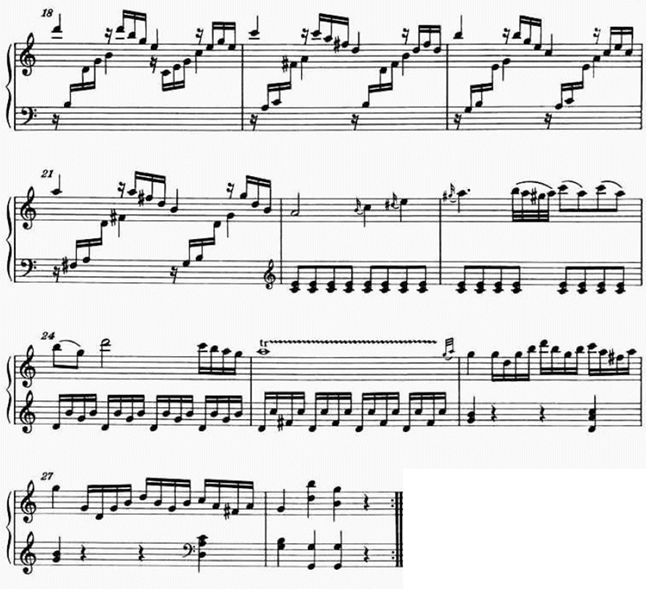
Example G2: W. A. Mozart, Piano Sonata in C major, Sonata facile, K. 545, i, mm. 1–28 (exposition)
Rarely, we opt for labeling evaded cadences as interthematic. One constellation is that of a deficient voice-leading at the point of cadential arrival with one or more parts failing to resolve to the goal tonic (see, e.g., Sonata in A minor K. 310, i, m. 35: here, the resolution of the trill from the previous measure in the upper voice is postponed by one sixteenth-note rest and transferred to a higher register). An extremely rare constellation involves the goal tonic occurring in wrong inversion (see, for instance, Mozart’s early piece K. 15r from the London Sketchbook where the only K4-type cadence attained throughout the exposition is arrived at in m. 21 in first inversion).
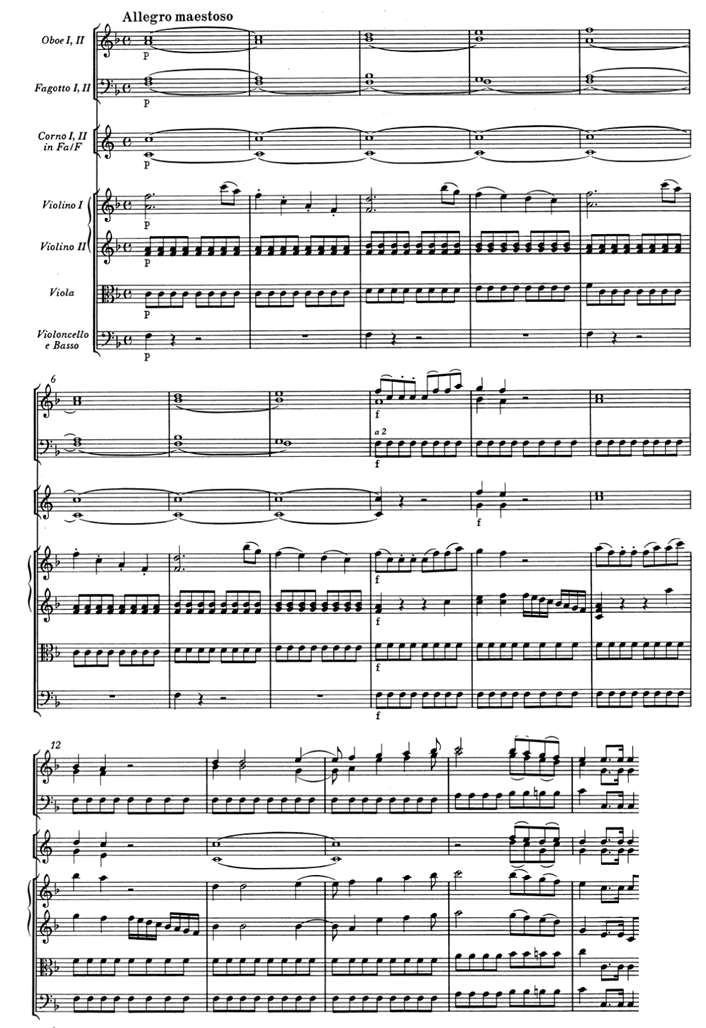
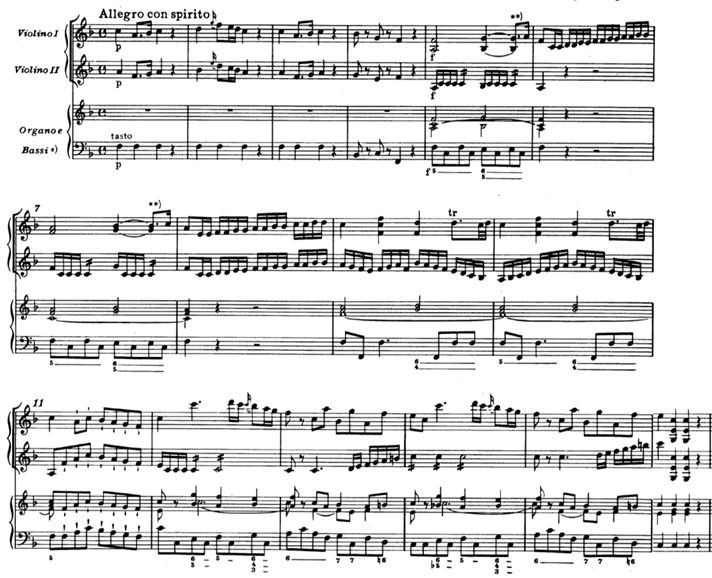
Exceptionally, certain “surrogate” progressions that establish the tonic degree without representing authentic cadences are also taken into account in our annotations based on contextual considerations. In some cases, an extended pedal point on the tonic critically impairs the functionality of the dominant degree in an otherwise authentic cadential progression, as, e.g., in the first movement of the Symphony K. 76 in F major (see Example G11): here, the dominant harmony at m. 8 is mounted over an ongoing tonic pedal point extending from the movement’s beginning—notably, in this exposition Mozart attains no stronger confirmation of the principal-key tonic, for which reason we label the impaired cadential arrival at m. 9 as a K1-type cadence. In other cases, the dominant degree is missing altogether, and the confirmation of the tonic is attained through a plagal progression (in which the subdominant degree substitutes for the dominant), as at the beginning of the Piano Piece in C major, K. 9a, mm. 3–4. Seldom, the tonic minor is construed to substitute for the (expected) major-mode tonic in the case that an authentic cadence is elided with a new beginning in the parallel minor (cf. the overture to Idomeneo, K. 366, m. 45 in Example G17 below).
Half cadences
The labels “K2” and “K3” pertain to half cadences in the home-key and the secondary tonic respectively. The great majority of the intertheromatic half cadences labeled in our corpus use a raised fourth scale degree to attain the goal dominant. Typical examples are found, e.g., in the first movement of Mozart’s Sonata for Two Pianos K. 448 (see Figure 1 in our main report), where both the (elided) K2- and the K3-type half cadences in mm. 24 and 25 are accessed through the raised fourth scale degrees G♯ and D♯ respectively (for a further example see Sonata facile K. 545, i, mm. 10–11 in Example G2 above). In the minor mode, raising the fourth scale degree prior to a half cadence often results in penultimate sonorities with augmented sixth, as, for instance, the Italian sixth chord in the first movement of the Great G minor Symphony, K. 550, m. 15 (Example G3).
Example G3: W. A. Mozart, Symphony in G minor, K. 550, i, mm. 1–42 (piano reduction)
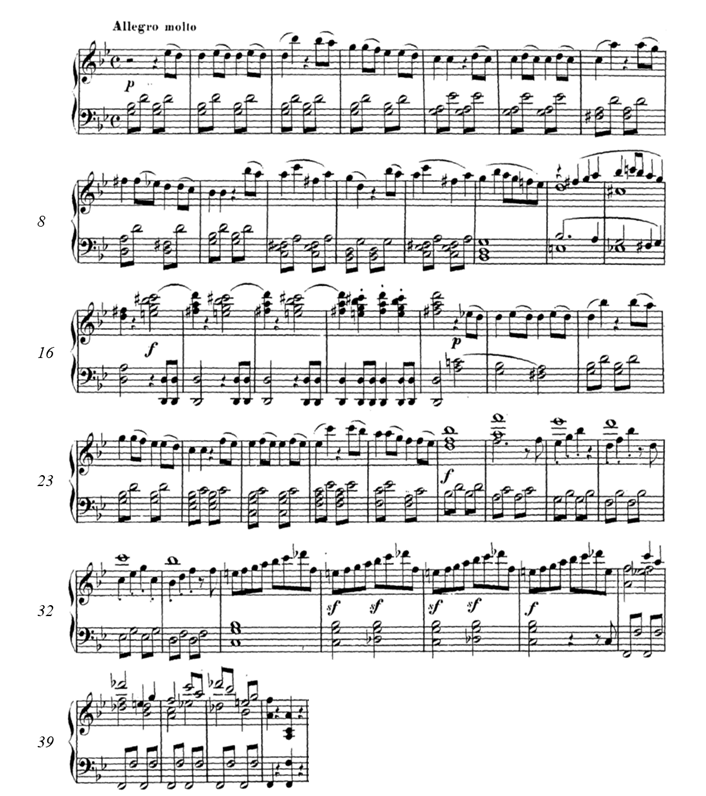
By and large, the repertoire under investigation shows half cadences not using the raised fourth scale degree to fulfil a merely local, intra-thematic punctuation function (often concluding the antecedent in period-like themes)— however, a small number of half cadences that do not employ the raised fourth scale degree are annotated as interthermatic. In a rare example in the first movement of the Symphony in G major, K. 74, m. 24, Mozart uses the natural (rather than the raised) fourth scale degree of the secondary key to approach an interthematic K3-type half cadence at m. 25. (A raised fourth scale degree is also missing in the abnormal arrival at a first-inversion dominant in the first movement of the Symphony in E♭ major K. 132, see Example G6 below.) In the finale of the Piano Sonata in E♭ major K. 282, a I-V half-cadence with a 6-4 suspension m. 8, which at first appears to represent a merely local, intra-thematic punctuation, is subsequently found to fulfill an interthematic function, as it is followed by a new theme in the dominant key. On a larger scale, the extensive K2-type half cadence in the first movement of the Jupiter Symphony K. 551, m. 19 (with extension through m. 23) is also attained via a simple I-V progression (see Example G4 and further discussion below).
Example G4: W. A. Mozart, Jupiter Symphony in C major, K. 551, i, mm. 1–57 (piano reduction)
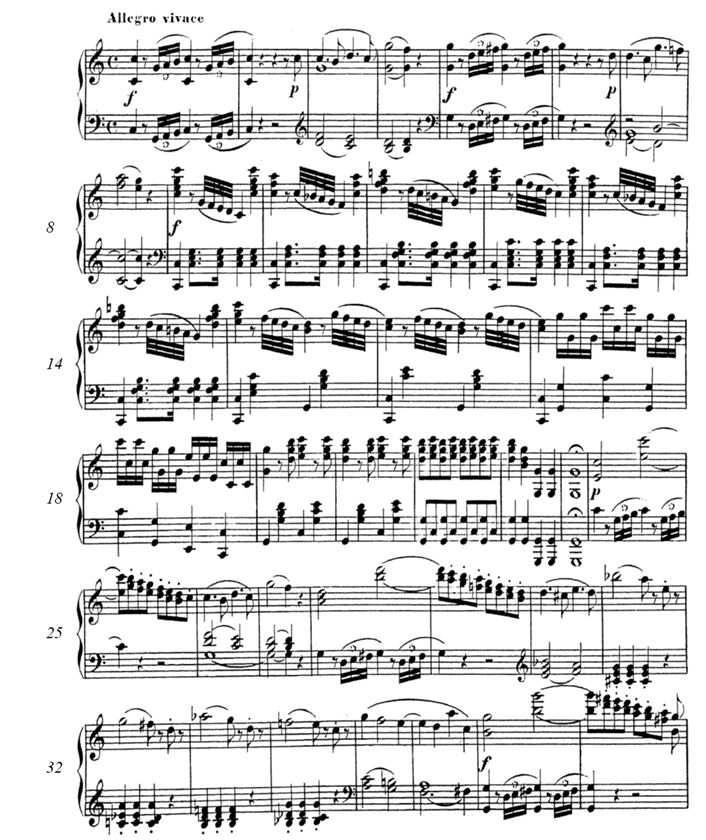
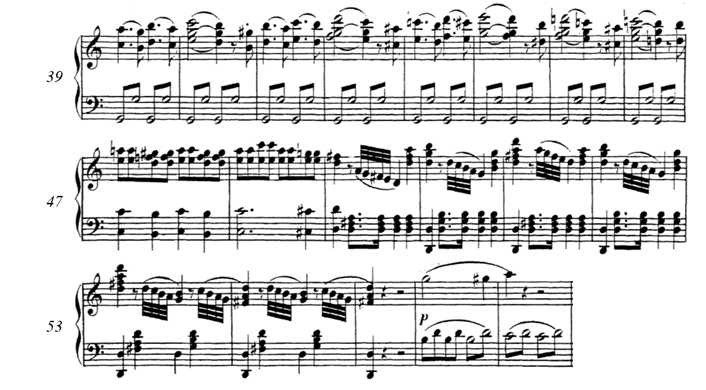
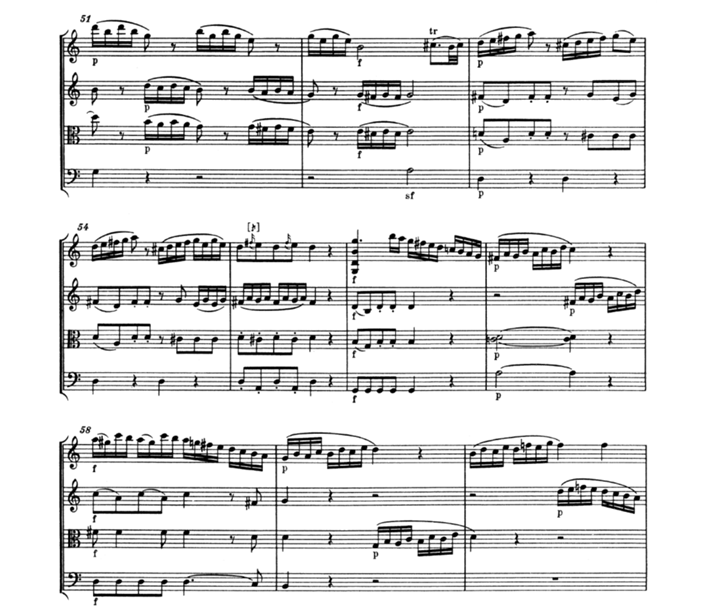
Based on an examination of Mozart’s piano sonatas, Martin and Pedneault-Deslauriers (2015) develop a typology of voice-leading patterns in half-cadential preparations. Their “simple I-V” paradigm seldom occurs among the half cadences annotated in our corpus, as it lacks the raised fourth scale degree which is, as discussed above, a typical feature of interthematic half cadences (but, again, consider the exceptions K. 74/i, K. 282/iii and K. 551/i discussed above). Their other three types—converging, expanding 6–8, and what they dub the “doppia half cadence”—are represented in the corpus under investigation at varying degrees of frequency. We draw attention to a further (rather infrequent) voice-leading option where the goal dominant is attained through its secondary dominant with an ascending fourth (or a descending fifth) leap in the bass. Due to the leaping bass motion, this voice-leading paradigm deceptively resembles that of an authentic cadence, as can be seen in Example G5 from the first movement of the Dissonance Quartet K. 465, where a K3-type half cadence (attained at m. 53 and extended through m. 55) locally assumes the appearance of an authentic one (cf. Kaiser, 2007, pp. 105f.). (Due to its “authentic” appearance, K2-type half-cadences using this voice-leading paradigm may be potentially confused—in major-mode movements—with K4-type authentic cadences which use the same pre-closural and closural degrees—the potential confusion between K2- and K4-type cadences will be discussed in some detail below.) A similar progression occasionally occurs also in minor-mode movements: see, for instance the dominant seventh chord on C preparing the K3-type cadential arrival on F in the first movement of the G minor Symphony K. 550 (seen Example G3 above). A further voice-leading pattern in conjunction with tonicized dominant arrivals is that of an applied dominant in third inversion that resolves to the goal dominant in first inversion. Although as a rule inverted dominant degrees may not fulfill a punctuation role, we construe some of these cases as elided/embedded half cadences and include them in our annotations (see detailed discussion of K2-type cadences below).
Example G5: W. A. Mozart, String Quartet in C major, Dissonance, K. 465, i, mm. 51–79
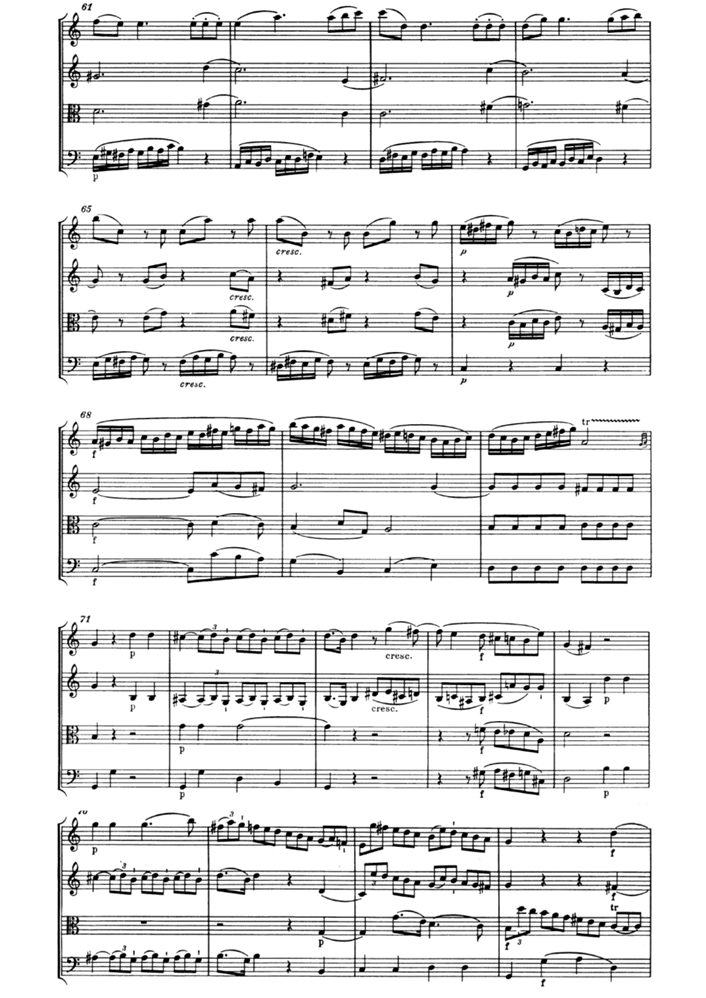
Half cadences that serve as interthematic punctuations present the goal dominant almost invariably in root position and, in most cases, in triadic form, that is, without the seventh. In very rare cases, the half-cadential arrival occurs in inversion, suggesting comparison with one of the evasion techniques described above with regard to authentic cadences, one such rare example being the K2-type cadence in the first movement of the Symphony in E♭ major, K. 132, arrived at in first inversion on the downbeat of m. 22 (see Example G6 below—we sense that the half cadence is already attained at this point, although an alternative reading may place the cadencial arrival on the downbeat of m. 26 with the dominant in root position). Another phenomenon suggestive of an “evaded half cadence” strategy involves one or more parts failing to resolve to the goal dominant at the point of cadential arrival—this occurs, e.g., in the first movement of the C minor Piano Sonata K. 457, where the secondary-key dominant’s bass and middle part are missing on the downbeat of m. 30 and complemented (at a higher register than the one prepared) on the next beat.
Example G6: W. A. Mozart, Symphony in E♭ major, K. 132, i, mm. 11–28
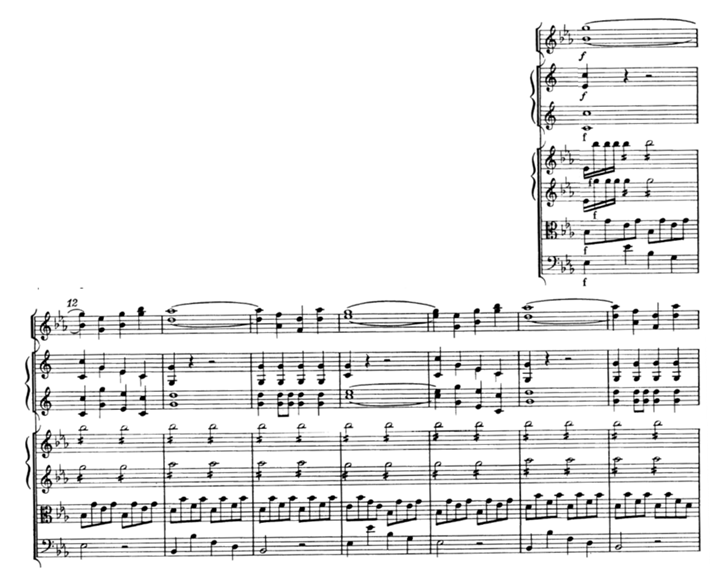
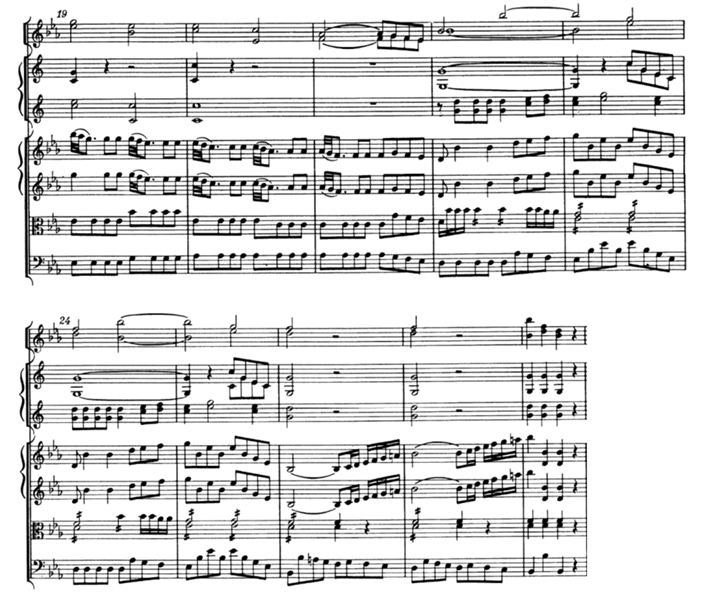
Interthematic half cadences are very seldom attained as dominant seventh chords at the point of credential arrival. In fact, in the repertoire under analysis there is only a single instance of a K2-type cadence arrived at as a dominant seventh: the fourth movement of the string Quartet in D major, K. 499, mm. 38–43. (Obviously, a K2-type half cadence attained—or prolonged—as a seventh chord may not be used to quit the home key for the dominant key. Whereas the latter procedure is the default option in Mozart’s major-mode movements subsequent to a triadic K2-type half cadence, dominant-seventh K2-type half cadences inevitably lead back to the home key.) In a similar vein, K3-type cadences attained as dominant seventh chords already at the point of cadential arrival are also quite rare in the analyzed repertoire—consider, for instance, the first movement of the Piano Trio in E major, K. 452, mm. 48–49, and the first movement of the Jupiter Symphony, K. 551, mm. 99–100 (note that in both cases, the cadential degree is arrived at through a subdominant degree borrowed from the parallel minor key). On the other hand, it is not uncommon for K3-type cadences arrived at in triadic form to turn into a seventh chord in the course of the postcadential extension (see, for instance, the first movement of the clarinet quintet 581, m. 35-41 in example G1 above). (Notably, in acknowledging certain half-cadences that involve inversions or the dissonant seventh we are at odds with Caplin’s assertion that “the dominant of the half-cadential progression must take the form of a root-position triad,” [1998, p. 29].)
2. General methodological considerations regarding interthematic cadences
Extrinsically/contextually, a closural event is ought to represent the ending of some musical segment; hence, cadential voice-leading alone is insufficient as a closural marker. (Notably, cadential harmony is often found in the middle of musical passages, where it does not fulfil any closural function.) Cadences may be recognized at a low (local) level, where they separate small segments inside a larger unit (Koch [1782–1793] generally refers to such lower-level closural events as “incises” [Incisionen] as opposed to the higher-level Absätze). However, we propose to include in our dataset only higher-level cadences. In eighteenth-century music, larger units are most typically represented by themes—we accordingly refer to the cadences in our corpus as “interthematic” cadences (as opposed to the lower-level “intra-thematic” cadences delineating segments inside a theme). In most cases, cadences that fulfil an interthematic function are also intrinsically clearly articulated. However, there is no binding correlation between the intrinsic and the extrinsic level: while intrinsically weak cadences (such as the evaded cadence and surrogate progressions discussed above) occasionally fulfil a “strategic” role in delineating major segments across the movement, intrinsically strong cadences may be located in the middle of a thematic module, making their contextual function a merely local one. The present section addresses general considerations and difficulties with regard to identifying interthematic cadences.
At the outset of our methodological considerations we postulate two categories of interthematic closure: theme-concluding cadences and theme-introducing cadences. The function of thematic conclusion is associated with an authentic cadence, whereas introducing a new theme is often (though not always) achieved through half cadences. Accordingly, we expect K1- and K4-type cadences to conclude thematic units, and K2- and K3 cadences to precede such units—although new themes may also be preceded by K4-type (and, much more seldom, K1-type) authentic cadences. (Occasionally, a single cadence may fulfil both functions, as in the case of K4-type cadences that both conclude the secondary-theme zone and launch the closing theme group, see, e.g., the elided cadence in the first movement of the Haffner Symphony K. 385, m. 74 in Example G20 below.) The criteria for identifying cadences of the two categories of interthematic closure differ fundamentally: for a cadence to be recognized as a theme-concluding cadence, the preceding section must display a sufficient degree of thematic completion upon reaching the point of closure, whereas identifying a theme-introducing cadence does not require any completeness of the preceding section, but rather a distinct new beginning to follow the closural event.
In the following, we define a set of principles used to identify and label interthermatic closural events. The principles discussed in the present section apply to all four closural types, whereas in the next section we discuss particular characteristics of specific types separately. Some of the principles result in increasing the number of cadential events labeled as interthematic, whereas others tend to decrease this number. For the sake of clarity, we begin by discussing the former cluster of principles.
Multiplicity of same-type cadences. In his discussion of the use of musical punctuation across a movement’s first Hauptperioden (i.e., the exposition section), Koch (1782–1793, vol. 3, pp. 366ff.) allows for more than one Absatz in the secondary-key tonic: according to Koch, an initial closure of the K4 type may be followed by an “appendix” (Anhang) terminating, in turn, with yet another K4-type cadence.
In our annotations we opt for a crucial distinction between multiple K4-type cadences on the one hand, and an apparent multiplicity of the other cadence types on the other. With regard to the exposition’s “closing zone” (following the “Essential Expositional Closure,” cf. Hepokoski and Darcy, 2006, pp. 180ff.), Koch’s concept of an appendix may be applied recursively to yield a succession of (as a rule: ever shorter) “appendices” piling up at an exposition’s end. To maintain consistency across the corpus, we acknowledge such appendices (closing themes and codettas) as contributing each an additional K4-type closure to the expositional closural scheme—in fact, as will be discussed below, a succession of several K4-type cadences represents the norm among Mozart’s sonata expositions. By contrast, a succession of other closural types is not part of the standard expositional design—for instance, following a sufficiently conclusive K1-type closure one expects the music to proceed to the secondary key area; “lingering on” to produce yet another K1-type main-tonic closure may be conceived of as retarding the “normal” course of events. Inasmuch as reiterated closural events of the types K1, K2 and K3 may be construed as resulting from extensions or codettas, we tend to subsume them under a single (extended) closural event, thus eliminating cases of consecutive same-type labels in our annotations (see principle “K1–3 codettas as postcadential extensions” below). However, under certain conditions we also apply the present “multiplicity” principle to K1–3-type cadences, resulting in successive same-type annotations—consider, for instance, the two consecutive K3-type cadences in the finale of the Symphony in G minor, K. 183, with cadential arrivals at mm. 24 and 37 (see Example G7 below).
Example G7: W. A. Mozart, Symphony in G minor, K. 183, iv, mm. 17–45
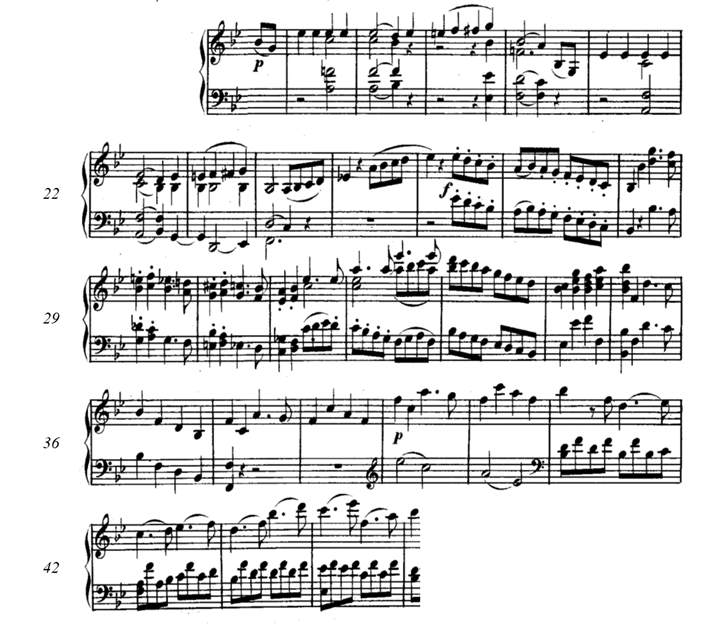
Temporal loops. Koch’s discussion of expositional punctuations does not involve cases of irregular succession of closural events; however, the idea that a movement may proceed to a closural event at a temporal position where it is no longer expected, thus creating the impression of a “temporal loop,” surfaces now and again in the analytical literature (see, for instance, Neuwirth, 2011; Hepokoski and Darcy, 2006, pp. 74f.). We propose that theme-introducing cadences may appear almost at any point throughout the exposition: a premature K2-type cadence may occasionally occur in the middle of the primary-theme zone (consider, e.g., Jupiter Symphony, first movement, mm. 19–23, see Example G4 above), or an additional secondary theme module may be introduced via a K3-type half cadence at almost any point of the secondary-key area (see, e.g., Jupiter Symphony, first movement, mm. 99–100). Whereas the principle of multiplicity discussed above allows for a succession of several cadences of the same type, the present principle also takes into account constellations in which interthematic cadences follow one another in a different order than the standard one prescribed by Koch. (Notably, a succession of interthermatic half cadences of the same type may also invoke the impression of a temporal loop—consider, e.g., the succession of two K3-type half cadences in the fourth movement of the G minor Symphony K. 183 at mm. 24ff. and 37ff. in Example G7 above, which introduce two thematic segments in the secondary key B♭ major, of which the former—in mm.28ff.—exhibits closing-theme characteristics, whereas the latter—in mm. 41ff.—sounds more like a veritable secondary-theme module.)
Elided interthematic cadences. Elided cadences lack one important characteristic of musical punctuations as discussed by Koch—the resting point (“Ruhepunkt des Geistes”): the simultaneous beginning of a new passage at the point of cadential arrival prohibits any cessation of the musical activity even for the shortest duration. From his discussion of the matter (1782–1793, vol. 3, pp. 384ff.), it is not quite clear whether Koch himself considers elided cadences to function as punctuations in the first place. However, for our analytical purposes it is obvious that elided cadences may fulfill interthematic functions: one straightforward case is that of the elided K1-type cadence at m. 17 in the first movement of the Sonata for Two Pianos K. 448 (see Figure 1 in our main report) which represents an unequivocal conclusion of the entire primary-theme zone notwithstanding its elision with the transition section’s beginning. The inclusion of elided cadences significantly increases the number of annotated interthematic cadences in our corpus, as can be gleaned from Table 2 in our main report.
Inclusion of declined mid-exposition caesuras. The concept of “medial caesura” goes back to Hepokoski and Darcy (1997 and 2006), who define it as “the brief, rhetorically reinforced break or gap that serves to divide an exposition into two parts, tonic and dominant (or tonic and mediant in most minor-key sonatas)” (2006, p. 24). Notably, the concept of a medial caesura does not appear in historical sources. Although eighteenth-century theorists such as Koch (1782–1793) and Riepel (1752–1768) base their understanding of musical form mainly on the phenomenon of musical punctuation, they generally opt for a multiplicity of mid-expositional caesuras, and, at any rate, do not explicitly single out any particular punctuation event as dividing the exposition in two.
The application of the medial caesura concept to Classical expositions is problematic, as individual expositions may contain from none to several mid-expositional caesuras. One relatively common constellation is that of two successive theme-introducing caesuras, most typically a K2-type half cadence and a subsequent K3-type one, each followed by new thematic material in the secondary key (see, for instance, the first movement of the String Quartet in C major, K. 157, with a new theme in the dominant key mediating between the K2-type cadence at m. 20 and the K3-type cadence at m. 30, and another one following the latter cadence). (Hepokoski and Darcy [2006, pp. 170-177] develop the concept of a “trimodular block” to handle such constellations that involve what they term “apparent double medial caesuras”; however, in our annotations we opt in such cases for labeling multiple closural events rather than selecting a single allegedly most significant one among them.) In other cases, two adjacent caesuras are separated by only a few transitory measures and not a thematic block in its own right, a constellation that undermines the theme-introducing function of the earlier of the two cadences—consider, for instance, the first movement of the Symphony in A major, K. 201, with an extensively articulated K2-type half cadence at mm. 23—27, followed, only two measures later, by another K3-type half-cadential arrival (see Example G8 below). In such cases, the first caesura is considered by Hepokoski and Darcy to represent a declined/failed medial caesura (2006, pp. 45ff.). The most extreme form of reducing the scope of a declined caesura is by confining it to the cadential arrival only, directly eliding it with the following passage (which, as a rule, somewhat later culminates in a veritable caesura used to introduce new thematic material)—this is the case, for instance, in the first movement of the Sonata for Two Pianos K. 48, m. 24 (see Figure 1 and discussion in our main report). We recognize a phenomenological affinity between multiple theme-introducing caesuras on the one hand (as in K. 157/i), and the constellation of declined or even elided mid-expositional caesuras on the other (as in K. 201/i and K. 488/i). We accordingly include such declined and elided cadences in our annotations as interthematic closural events, notwithstanding the fact that they do not materialize as such (consider, e.g., the two half-cadential arrivals in K. 448/i, mm. 24 and 25, see Figure 1 and discussion in our main report).
Example G8: W. A. Mozart, Symphony in A major, K. 201, i, mm. 1–32 (piano reduction)
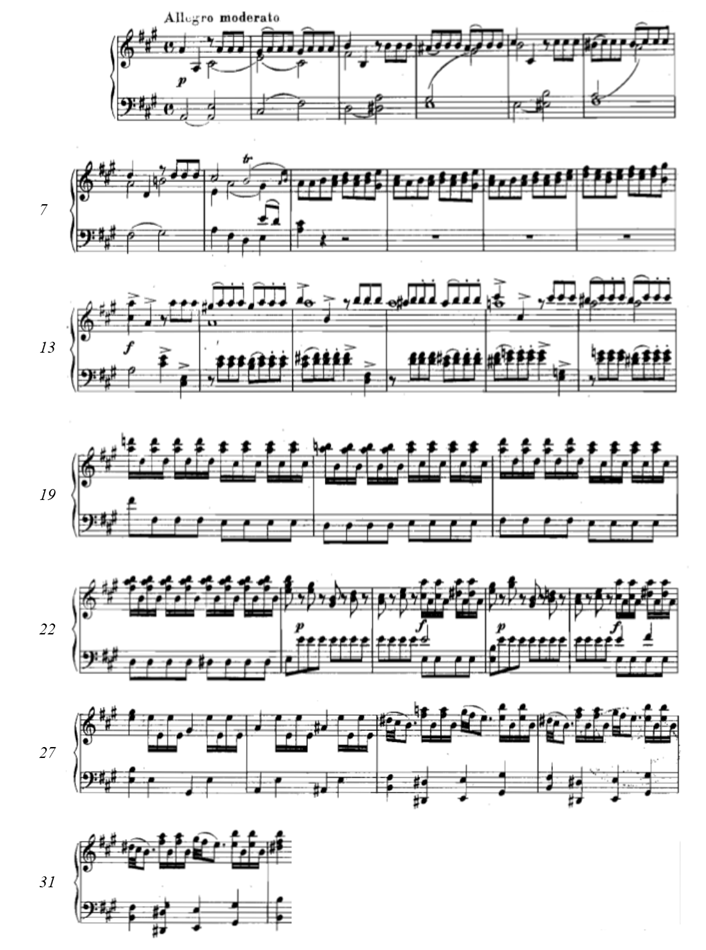
Half cadences that are rejected as theme-introducing caesuras may be either elided or embedded within an ongoing transitional passage without being elided. An elision may occur either directly at the point of cadential arrival (as in the case of the K2-type cadence in the first movement of the Sonata for Two Pianos K. 448 on the downbeat of m. 24, see Figure 1 in our main report), or indirectly, that is, following a postcadential extension (as in the same movement, m. 30—here, a K3-type half cadence attained at m. 25, and extended through m. 30 is elided with a short interim passage that concludes with an authentic cadence a few measures later). However, in some cases there is no elision in the strict sense of the word. Consider, for instance, the K2-type half cadence in the first movement of the A major Symphony K. 201 (see Example G8 above), mm. 23–27: the end of the postcadential space at the downbeat of m. 27 is closely followed by—but not elided with—a short transitional passage beginning on the second quarter note of the same measure. The difference between elided cadences (such as K. 448/i, mm. 24 and 25–30) on the one hand, and cadences that are embedded but not elided (such as K. 201/i, mm. 23–27) on the other may appear nonessential, as both types represent rejected theme-introducing closural events—however, in our annotations we take account only of veritable elisions and supply no information regarding embedded cadences that are non-elided. Thus, it is impossible on the basis of our annotations to directly distinguish between half cadences that materialize as theme-introducing caesuras (such as, e.g., the K2- and K3-type cadences in K. 157/i, mm. 20 and 30 respectively, each of which introduces a new thematic module), and rejected caesuras that are embedded but non-elided (as in the case of the embedded K2-type cadence in K. 201, mm. 23–27). However, indirect inference is possible, as rejected interthematic cadences are as a rule shortly followed by yet another closural event, as opposed to theme-introducing cadences which are followed by a (longer) thematic presentation.
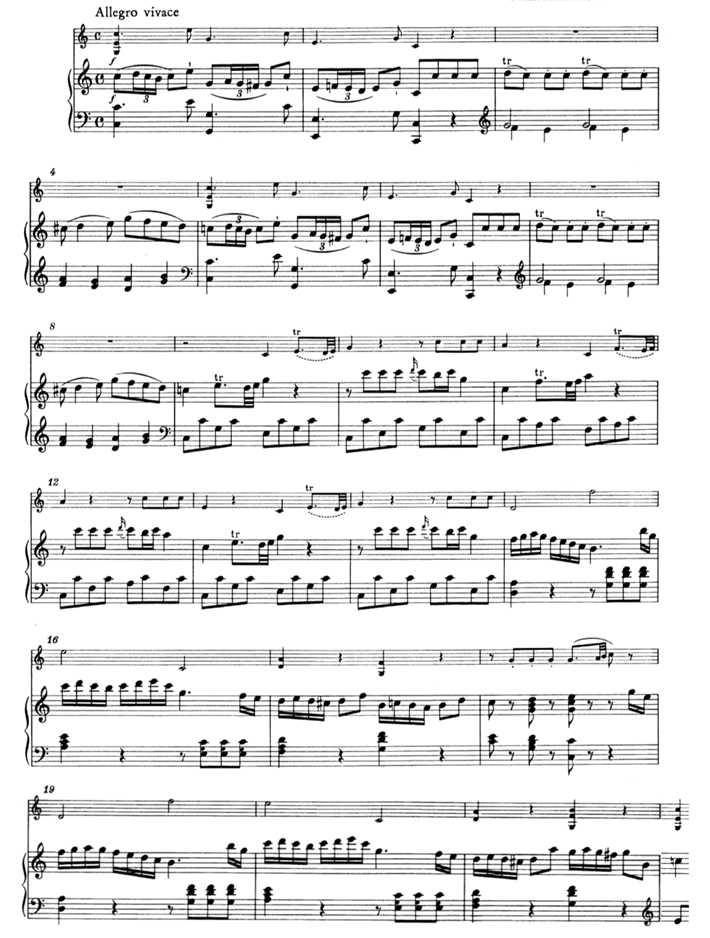
“Moving on” rhetoric. This principle contributes toward identifying higher-level (interthematic) cadences at points where the musical rhetoric suggests the beginning of a new section, regardless of the degree of thematic completion of the preceding section (see discussion of thematic completion principle below). This particularly pertains to situations where the music seems to be “moving on” not only to a new thematic module, but rather to a new section along the expositional trajectory (e.g., from the primary theme to the transition section, or from the secondary theme on to the closing zone). Consider, for example, the cadence at m. 9 in the first movement of the Violin Sonata in C major, K. 296 (see Example G9 below): the preceding thematic presentation consists of two near-identical statements (mm. 1–4 and mm. 5–8 respectively), a constellation suggestive of a sentential presentation phrase that requires thematic continuation (see principle of thematic completion below); however, the new elided section beginning at m. 9 displays the rhetorical characteristics of a transition section (heightened rhythmical activity, loud dynamics), thus granting the preceding closural event an interthematic status as a dividing point between two expositional zones: primary theme and transition (note that ultimately, the alleged transition in mm. 9 – 22 doesn’t materialize as such and concludes with yet another K1-type closure). As musical rhetoric is a complex phenomenon largely dependent on listeners’ perception, knowledge, and expectations, the “moving on” principle, based on modern annotators’ perception, lays no claim to a historical, nor to an objective mode of analysis.
Example G9: W. A. Mozart, Violin Sonata in C major, K. 296, i, mm. 1–22
Whereas the five principles specified above contribute toward increasing the number of labeled interthematic cadences in a given exposition, we now turn to discuss a group of methodological principles that, conversely, limit the number of cadences annotated in our corpus.
Thematic completion. The closure types that may conclude a theme are the two types representing authentic cadences: K1 and K4. In order to identify a given closural event as a theme-concluding one, sufficient thematic completion is required at the point of closure. We base our criteria of thematic completion on the structural norms of Classical themes as postulated in the analytical literature. Schoenberg (1967), Ratz (1973), and Caplin (1998) distinguish between two basic thematic templates: the sentence and the period. The sentence’s first half (“presentation phrase” according to Caplin)—itself consisting of two elements (the “basic idea” and its immediate repetition)—necessitates a subsequent “continuation phrase.” The essentially symmetrical period consists, by contrast, of only two elements (which may, in turn, represent a complex structure at a lower hierarchical level)—antecedent and consequent—which complement one another and require no further continuation. As a rule, interim closural events that conclude a sentence’s basic idea (or presentation phrase), or a period’s antecedent are not considered to attain sufficient thematic completion, and any interthematic annotations are deferred to the end of the entire sentence/period. However, as will be discussed below especially with regard to K1-type cadences, we opt for annotating also certain mid-thematic closural events as interthematic. In addition, the sentence and the period structure occasionally operate at different hierarchical levels, thus engendering contradicting assessments of the degree of thematic completion at a given point. By identifying, for instance, the first eight measures of Mozart’s Jupiter Symphony (see Example G4 above) as a period (as in Dahlhaus, 1975, p. 440; Kühn, 1987, p. 56), these measures are granted a sufficient degree of thematic completion justifying labeling the cadence in m. 8 an as interthematic one. But if, on the other hand, these measures are construed as a presentation phrase in a larger sentence, extending from the movement’s beginning to m. 23 (with mm. 1–4 figuring as a compound basic idea and mm. 5–8 as its repetition), the same eight measures call for a subsequent continuation phrase and may not be considered thematically complete (this interpretation is suggested, e.g., by Waldura, 2002). Ultimately, our decisions depend on a holistic perceptual case-to-case evaluation of complex constellations. As demonstrated by the discussion of the secondary themes of K. 465/i and K. 563/i below (see Examples G5 and G21 respectively), specific instances involve contradicting aspects that both support and negate identifying a given closure as interthematic. In addition, requirements of thematic completion vary across the different zones of a sonata exposition: whereas the primary and secondary themes are generally expected to exhibit a complete sentential or periodic structure, post-secondary-theme closing themes and codettas, for instance, often attain a sense of completion without fulfilling the requirements of a full -fledged sentential/periodic design.
Repetition. Even where a thematic presentation attains satisfactory grammatical completion according to the above-discussed principle, a closural event concluding it may be subsequently canceled as an interthermatic punctuation if it is followed by an immediate repetition of preceding material. In fact, it is immaterial how elaborate thematically and grammatically the preceding passage is: any immediate repetition overrides, so to speak, the closural effect by indicating that the thematic idea has not come to an end as yet. Among Mozart’s secondary themes there are numerous examples for passages that are rephrased rather than literally repeated—consider, for instance, the passage in mm. 93–104 of the Linz Symphony (K. 425) finale, which is immediately repeated in a substantially altered form in mm. 105–116 where it is transferred to the minor mode with an underlying pedal point and under profound motivic transformation. When the impression arises that a given passage rephrases—however remotely—an immediately preceding one, we opt for suppressing the intermediate closure in our annotations.
We propose further three principles that contribute towards limiting the number of annotated interthematic cadences.
Pedal point. This principle implies that passages supported by a prolonged pedal point (that may also be rhythmically broken, e.g., into eighth-note repetitions) on a certain scale degree (usually the tonic or the dominant) represent continuous units also in the sense that they engender no further segmentation by interthematic cadences. There are only a few deviations from this rule, mainly in conjunction with primary themes that are sometimes considered to attain a (weak) K1-type closure over a prolonged tonic pedal point—for lack of a more clearly articulated authentic cadence (see discussion of K1-type cadences below). We apply this principle in particular to expositional codettas that are often based on a pedal point—we accordingly refrain from annotating additional K4-type cadences at the end of codetta modules that are supported by a through-going pedal point.
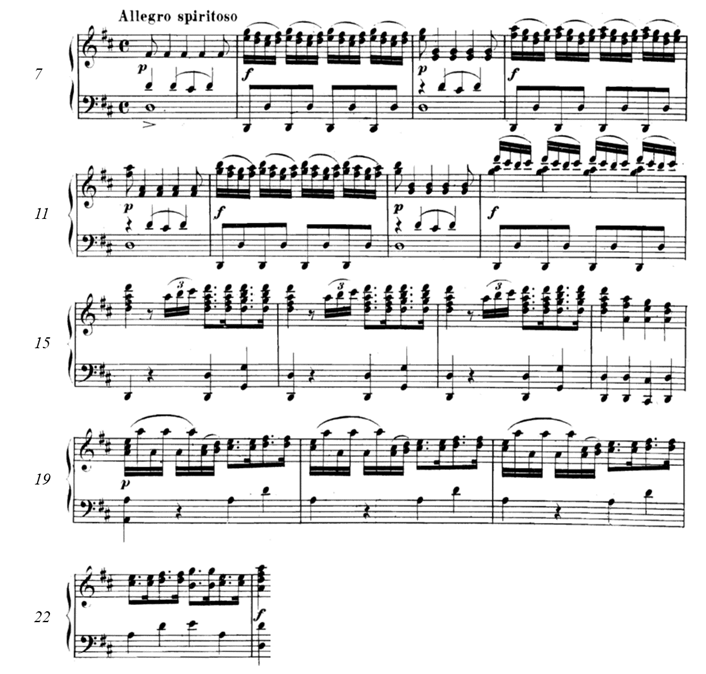
Culmination. This principle implies that whenever a passage represents a gesture of culmination (e.g., by invoking the characteristic device of the “Mannheim crescendo”), it will be construed as “spilling over” into the next passage, and any intermediate cadential event will be suppressed in our labeling. The culmination device is often used in conjunction with a bass pedal point, as, e.g., in the first movement of the Serenade in D major, K. 320 (see Example G10 below), where what may be perceived as a K1-type cadential arrival on the downbeat of m. 15 is disregarded in our annotations owing to the use of both a pedal point and a melodic culmination in the preceding passage (note that in this case there is no crescendo supporting the melodic ascent throughout the passage in mm. 7–15). A further example of the culmination principle—this time without a pedal point (however, with a similar reiteration of the tonic degree on every downbeat) and without pitch ascent—occurs in the first movement of the Paris Symphony in D major, K. 297, mm. 27ff., where we consider the new motive beginning at m. 32 to continue the preceding crescendo passage with no cadential segmentation at this point.
Example G10: W. A. Mozart, Posthorn Serenade in D major, K. 320, i, mm. 7–23 (piano reduction)
K1–3-type Codettas as postcadential extensions. This principle implies that codettas to K1-, K2- and K3-type cadences will be generally construed as postcadential extensions (whether or not underlined by an ongoing pedal point), and accordingly subsumed under the preceding closural event—thus potentially reducing the number of labeled cadences in our dataset. The present principle also accounts, for instance, for cases where no unifying pedal point is present throughout the extension passage, a typical example being the beginning of Mozart’s Clarinet Quintet (see Example G1)—here we identify a K1-type cadential arrival at m. 15, whereas the next four measures—oscillating between the tonic and the dominant—are construed to represent no self-sufficient thematic module, but rather a short “codetta” attached to the previous thematic presentation and extending the postcadential space from m. 15 through the beginning of m. 19. As discussed above, codettas occurring subsequent to K4-type cadences as a rule do not count as extensions (unless underlined by an ongoing pedal point), but are rather construed as individual closural events. Regarding “half-cadential codettas” of the types K2 and K3, see further discussion below.
Further criteria for labeling interthermatic closural events are discussed in the following section in conjunction with specific closural types.
3. Methodological considerations regarding specific closure types
K1-type cadences
Interthematic cadences of the K1 type are expected to conclude the primary-theme presentation (or any sufficiently independent thematic module in the primary theme zone).
The most straightforward constellation is that of a primary-theme presentation that concludes with a perfect authentic cadence on the primary-key tonic, subsequently followed by new thematic material (often of transitional character) that isn’t any more part of the theme. As a rule, we expect primary themes to attain thematic completion based on the building rules for sentences and periods (or any hierarchically nested combination of both). In first sonata-allegro movements (i.e., movements that inaugurate a cycle such as a symphony or a sonata), a sentential design is common (see, e.g., K. 448, i in Figure 1 in our main report, where the K1-type closure at m. 17 concludes a compound-sentential primary theme). By contrast, primary themes displaying a regular periodic design—with an antecedent that ends on the dominant and a consequent that ends on the tonic—are atypical for Mozart’s first movements, but quite common among his sonata-form finales, one example being the finale theme of the Symphony in B♭ major K. 319, with a mid-thematic half cadence concluding the antecedent at m. 16 and a final perfect authentic cadence at the period’s end in m. 32. (Such periodic primary-theme design—otherwise highly typical of Mozart’s rondo and sonata-rondo refrains—grants many of his finales a touch of the sonata-rondo, without making them sonata-rondos proper). In some sonata-form finales Mozart further opts for a refrain-like theme in the rounded binary form (see, e.g., the fourth movement of the Dissonance Quartet in C major, K. 465, mm. 1–34, or the finale of the Symphony in G minor, K. 550, mm. 1–32, where Mozart’s original repeat signs—particularly indicative of a refrain-like design—are replaced by the written-out passages in the Neue Mozart Ausgabe)
A contextually strong K1-type cadence that concludes the entire primary theme—insofar as one is to be located in a given exposition—is considered to override any preceding mid-thematic cadences that optionally occur throughout the thematic presentation, so that only the final closure is labeled in our corpus (but see further discussion of primary-theme codettas and “mock-transitions” below). However, many sonata-movement primary themes do not attain a sufficient thematic completion on the principal-key tonic, and the only closure of sufficient thematic weight in the principal key is of the K2 type (consider, e.g., the first movement of the Sonata facile, mm. 11–12, see Example G2 above). To handle such cases, we formulate the following principle which as a rule guarantees at least one K1-type label in an exposition (unless none can be located—see, e.g., discussion of K. 133/i below), but, at the same time, limits the number of deficient K1-type cadences labeled in our corpus:
Point of maximal confirmation of the principal-key tonic. We argue that inasmuch as a given exposition lacks a proper K1-type cadence with sufficient thematic weight, thematically (or even harmonically) deficient closural events of the K1 type that can be located in the music assume a non-local, strategic role in establishing the home-key tonic. Accordingly, we opt in such cases for labeling the point of maximal confirmation of the principle-key tonic as K1 disregarding its thematic deficiency; however, in the absence of a proper K1-type cadence, we strive to limit the number of deficient K1-type cadences labeled in the corpus to a single one per exposition.
By applying the rule of “maximal confirmation,” we opt, for instance, for labeling the imperfect cadence attained in the middle of m. 4 in the first movement of the Sonata facile (see Example G2) concluding the theme’s presentation phrase as a K1-type cadence for the lack of any stronger confirmation of the home-key tonic in this exposition. This principle also admits labeling surrogate harmonic progressions such as, for instance, the plagal progression in the Piano Piece K. 9a, m. 3–4, or the deficient cadential arrival in the first movement of the Symphony in F major, K. 76, m. 9 (Example G11 below), which takes place over an ongoing pedal point (note that in both these latter cases, the principle of maximal confirmation overrides the pedal-point principle discussed above). Owing to the principle of maximal confirmation, only ten expositions (out of 297) in our corpus lack a K1 label (arguably, the deceptive cadence in the first movement of the Symphony in D major, K. 133, m. 10 substitutes for the missing tonic confirmation—however, although we acknowledge certain deficient cadential progressions in our guidelines, we don’t go as far as labeling deceptive cadences as “K1”).
Example G11: W. A. Mozart, Symphony in F major, K. 76, i, mm. 1–16
In the case of primary themes failing to produce sufficient thematic closure on the principal-key tonic, there are often several deficient K1 candidates—however, as suggested by the principle of maximal confirmation, we aim to select only the most significant among these tentative cadences for labeling as “K1.” The closural strength is measured primarily by extrinsic, contextual parameters rather than by the cadence’s intrinsic strength: for instance, the authentic cadence attained in the middle of m. 2 of the Sonata facile first movement (see Example G2) is arguably stronger harmonically than the one attained in m. 4, as the former cadence has the harmonic root in the upper voice while the latter has only the third (both cadences are imperfect due to the inverted dominant)—nonetheless, it is the intrinsically weaker cadence at m. 4 that is labeled in our corpus due to the fact that it stands higher in the formal hierarchy (it concludes the entire presentation phrase of the sentential structure in mm. 1–12, whereas the earlier cadence in m. 2 concludes only the basic idea’s initial statement).
From this example, it may appear that it is the temporally most recent of multiple tentative K1-type cadences which is considered to be contextually the most significant one. However, we apply the recency principle only in cases where it is not overridden by other, more substantial principles of formal hierarchy. For instance, in some sentence-like themes whose presentation phrase ends on the tonic the subsequent continuation phrase displays, in turn, a nested sentential structure consisting of a (subordinate) presentation phrase that ends on the tonic and a (likewise subordinate) continuation phrase ending on the dominant. In such cases, it is rather the earlier of the two authentic cadences that is selected for labeling, as it concludes the main sentence’s presentation phrase, whereas the later one concludes only a nested lower-level presentation phrase. (See, e.g., Church Sonata in F major, K. 224 in Example G12 below: the end of the presentation phrase at m. 4—consisting of twice a two-measure unit—is selected for labeling as K1, rather than the later cadence at m. 8 which similarly concludes a presentation phrase, however, at a subordinate hierarchical level.)
Example G12: W. A. Mozart, Church Sonata in F major, K. 224, mm. 1–16
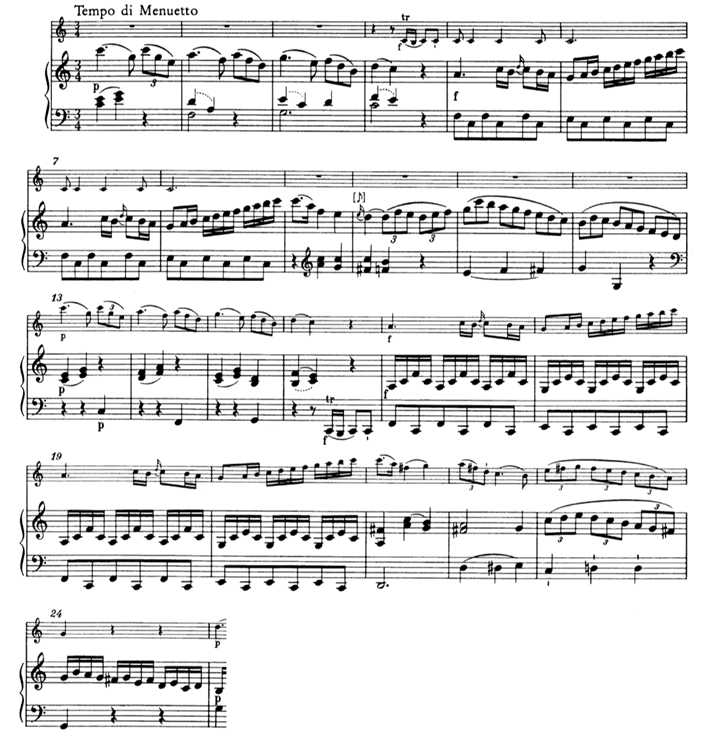
As a rule, we apply the recency principle only in the case of several mid-thematic tentative K1-type cadences that are located at the same hierarchical level. One such case is the period-like opening theme of the Clarinet Quintet K. 581 (see Example G1), where both the antecedent and the consequent end on the tonic: here we select the imperfect cadence concluding the consequent at m. 15 (extended by a postcadential codetta through m. 19), rather than its near-identical counterpart occurring eight measures earlier in m. 7. (Note that in this case, the K1-type closure in mm. 15–19 also concludes the entire thematic presentation.) In a similar vein, in period-like primary themes whose neither antecedent nor consequent end on the tonic, we pick among several comparable lower-level closural events the most recent one for labeling as “K1”: for instance, among the two tentative arrivals on the tonic in the main theme of the Violin Sonata in C major 303, second movement (see Example G13 below), we annotate as “K1” the later one located halfway into the consequent (m. 16, second beat) rather than the (equivalent) earlier one occurring at a comparable position of the antecedent (m. 4—notably, in the case at hand both higher-level cadences concluding the antecedent and the consequent at mm. 12 and 24 respectively are of the half-cadential type).
Example G13: W. A. Mozart, Violin Sonata in C major, K. 303, ii, mm. 1–25
Primary-theme codettas occur with some regularity among Mozart’s sonata-allegro movements—we note an increased employment of this device among the composer’s later works. As discussed above in conjunction with the principle of K1–3-type codettas, we refrain from labeling the conclusion of primary-theme codettas as additional K1-type cadences (provided that the theme’s main module has already provided a sufficient K1-type closure). Instead, we subsume the entire codetta(s) under the postcadential space of the preceding K1-type closure, thus suggesting that they represent hierarchically subordinate events. This may seem obvious enough with regard to short extensions of the cadential tonic (as, e.g., in the four measures of violins alone extending the K1-type cadential arrival at m. 9 of the Symphony in A major, K. 201, first movement, see Example G8 above), or tonic-dominant-pendulum passages enhancing the primary-theme presentation (as in the Clarinet Quintet K. 581, first movement, mm. 16–19 in Example G1). However, to vouchsafe methodological consistency across the corpus, we also subsume under postcadential extensions more substantial primary-theme codettas that may even present new thematic material. The horn-call imitation in the first movement of the Piano Sonata in F major, mm. 13–22 introduces a new motive and thus merits consideration as an independent thematic module in the primary-key area; however, as these measures do not amount to a standalone thematic presentation, we opt for construing them as a postcadential extension of the K1-type closure at m. 12 which, in turn, concludes the quasi-sentential primary-theme presentation in mm. 1–12. In the third movement of the same sonata, Mozart initially invokes the impression of a binary-form refrain, with the opening period (mm. 1– 14) assuming the role of the first reprise, and the subsequent measures that of a binary second part; however, as soon as a complete rounded-binary design fails to materialize, we revise our understanding of mm. 15ff. construing them as a primary-theme codetta—a little later, mm. 22–35 even add a “codetta to the codetta” (these measures are suppressed in the recapitulation and return only as the entire movement’s final coda). In our analysis, the entire section mm. 14–35 is construed as a postcadential extension of the (singly annotated) K1-type cadential arrival at m. 14.
Although construing primary-theme codettas as K1-type postcadential extensions reduces the number of successive K1 annotations in our corpus, not every post-K1-type-cadence element that still remains in—and closes on—the home-key tonic is construable as a codetta. We point to some exceptions in conjunction with the principle of “moving on” rhetoric (see discussion above), that is, cases where a “mock transition” subsequent to a theme-concluding K1-type cadence fails to attain a K2-type half cadence in the principal key or to directly modulate to the secondary key, re-arriving, instead, at yet another K1-type closure. For instance, although the elided passage in the first movement of the E♭ major Symphony K. 543, mm. 54–71, located between two tonic arrivals, may be tonally speaking construed as a mere postcadential extension of the earlier K1-cadence at m. 54, we argue that the evident transition characteristics of this passage impose a mode of hearing it as a new beginning—accordingly, we opt in this case for notating two successive K1-type cadences at mm. 54 and 71.
Another category of “mock transitions” is represented by K2-type cadential arrivals that are not used to quit the home key and/or end the primary subject. As in the great majority of Mozart’s expositions (this is particularly true for major-mode movements) that possess a K2-type closure this cadence is used to quit the primary-key area, we construe a return to the primary key subsequent to a K2-type cadence (as, e.g., in the opening movement of the Jupiter Symphony K. 551, m. 24) as a “failed” transition. This leads in some cases to a double K1 annotation in an exposition, involving one K1-type cadence annotated according to the principle of “maximal confirmation of the principal-key tonic” prior to the failed transition, and a second one following the K2 label, provided that the home-key tonic is then re-established with a thematically significant closure (consider our analysis of the first movement of the Violin Sonata in G major, K. 301, with a sentence-concluding K1-type closure at m. 8, an aborted-transition K2 label at m. 12, and a theme-concluding extended K1-type cadence at mm. 20–28. By contrast, any tentative K1-type cadence—e.g. in the transition section proper—that occur subsequently to a thematically strong one are ignored (see, e.g., the mid-transition tonic arrival in the finale of the Symphony in E♭ major, K. 543, m. 24—this local cadence is not included in the corpus).
K2-type cadences
Half cadences in the primary key do not automatically qualify as interthematic K2-type cadences. For example, half cadences concluding the antecedent in period-like primary themes have a merely local, intra-thematic function. However, in some cases a primary-theme antecedent may stand out as particularly long and complex—this is suggested by the concept of “grand antecedent” coined by Hepokoski and Darcy (2006, pp. 77ff.). In such cases, we annotate the relevant half cadence as a “K2,” notwithstanding the fact that the primary-theme presentation is ongoing with the subsequent period’s consequent still beginning in the principal key (for a typical example of the “grand antecedent” design, see mm. 1–23 in the first movement of Mozart’s Jupiter Symphony, K. 551 in Example G4). Notably, our analyses show the grand antecedent to represent a fairly rare design among Mozart’s sonata-allegro movements.
As may be gleaned from Table 2 in our main report, the great majority of K2-type cadences in the repertoire under analysis directly precede passages in the secondary key, making such half cadences a medium of modulating between the principal key and the secondary key area. This informs the following principle:
Delineation of principal-key area. Marking off the end of the principal-key area is a global, strategic event in the exposition’s trajectory—even in the absence of a new thematic beginning subsequent to the closural event. Accordingly, whenever mediating between the primary and the secondary key area, we annotate half cadences in the main key as interthematic “K2” cadences regardless of their harmonic strength or thematic role.
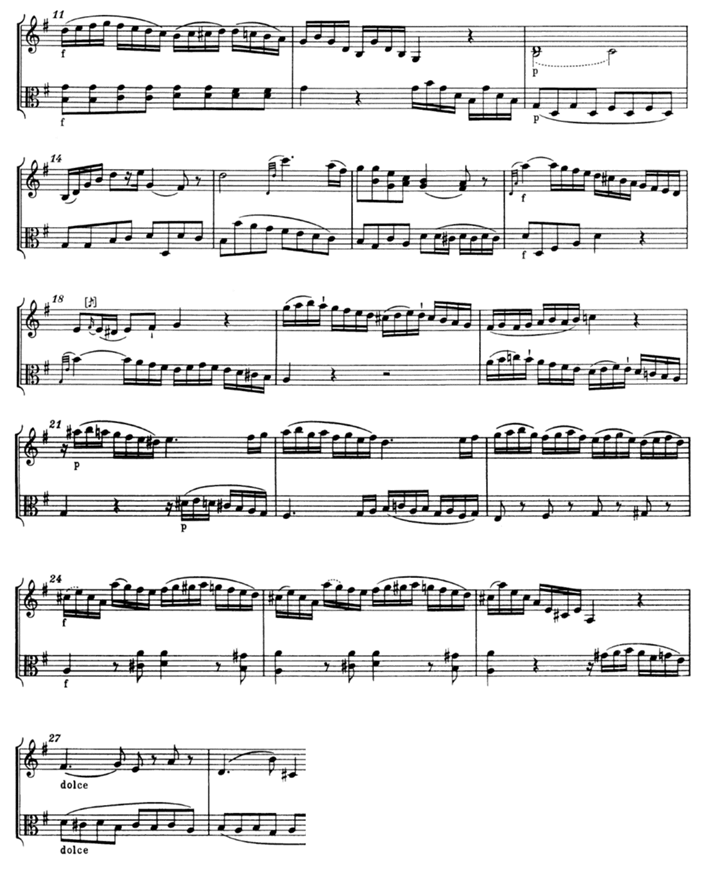
The most straightforward constellation is that of a theme-introducing K2-type cadence that directly precedes the onset of the secondary theme, as, for instance, in the first movement of the Sonata facile, mm. 11–12 (see Example G2). (This constellation essentially corresponds with the concept of the “bifocal close,” cf. Winter, 1989.) Optionally, a theme-introducing K2 cadence may be followed by merely subordinate thematic material in the secondary key (“not yet” the secondary theme “proper”)—consider, for instance, the passage in mm. 17–26 in the first movement of the Duo for Violin and Viola in G major, K. 423, in Example G14 which may be construed as a “transition theme.”
Example G14: W. A. Mozart, Duo for Violin and Viola in G major, K. 423, i, mm. 11–28
However, as discussed above in conjunction with the inclusion principle, many K2-type cadences do not materialize as theme-introducing caesuras at all. Occasionally, the subsequent passage may be reduced to just a few transitory measures of no thematic substance (as in the first movement of the Symphony in A major, K. 201, mm. 27–29, see Example G8 above). Some K2-type cadences may even go almost unnoticed due to elision with the subsequent unit (see, e.g., Sonata for Two Pianos K. 448, i, mm. 23–24 in Figure 1 in our main report; Jupiter Symphony K. 551, i, mm. 37 in Example G4). In accordance with the delineation principle and the above-discussed principle of inclusion, all such cadences are included in the corpus in spite of their inferior thematic role. An intriguing case occurs in the first movement of the Clarinet Quintet K. 581, mm. 19ff. (see Example G1)—here the half cadence at m. 26 behaves in all but its tonal embedding like an intra-thematic closure located halfway into a tightly knit transitional theme beginning at m. 19; however, having the shift from the tonic to the dominant key occur directly at this point grants this cadence a higher-level significance and leads to its inclusion in our annotations.
A particularly deficient voice-leading paradigm in conjunction with dominant arrivals in the home-key is that of an applied dominant in third inversion (V2/V) that resolves to the goal dominant in first inversion (V6). Many transition passages in major-mode movements quit the home key using this progression (see, e.g., Symphony K. 543, iv, m. 32–35). In the first movement of the Symphony in D major, K. 202, for instance, the dominant degree, arrived at on the downbeat of m. 18 in first inversion, is subsequently extended through m. 22 and re-established as a root-position chord (see Example G15 below). In the repertoire under analysis, first-inversion dominants attained via the above-described voice-leading paradigm do not materialize as veritable theme-introducing K2-type cadences (even the extended dominant in K. 202/i is embedded in a transitional passage that culminates in a theme-introducing K3-type cadence in mm. 23–26)—which may be explained by their particularly weak articulation of the half-cadential dominant. However, in accordance with the principles of delineation and inclusion, we construe even such weakened dominant arrivals to represent elided/embedded K2-type cadences and include them in our labeling (note that the point of cadential arrival even in these weakened cases demarcates the shift from the main-key to the secondary-key area).
Example G15: W. A. Mozart, Symphony in D major, K. 202, i, mm. 12–26
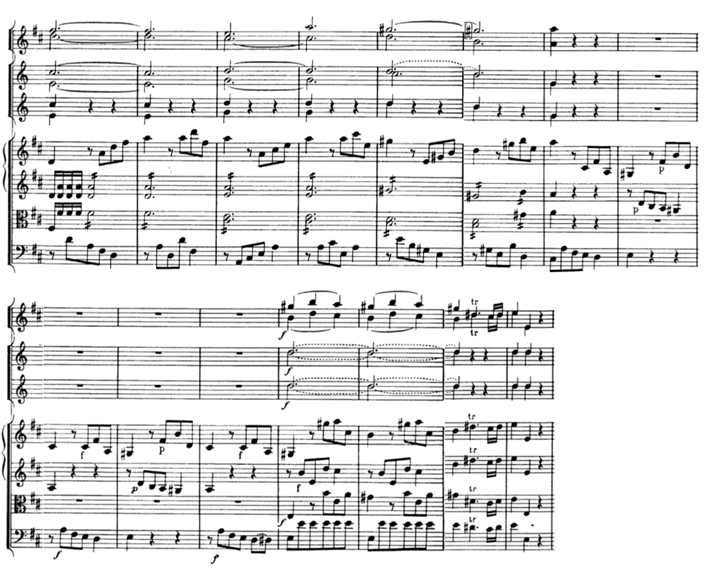
In order for a closural event to be labeled as a K2-type cadence, it is required that the cadential arrival be perceived as still occurring in the principal key. In several major-mode expositions, Mozart uses a tentative tonicization of the sixth degree as a means of initiating the modulation to the dominant key (see, e.g., Divertimento for String Trio in E♭ major, K. 563, i, mm. 19–23, Example G21 below)—in such cases we construe any subsequent elided/embedded arrivals on the home-key dominant to be already in the dominant-key area (or, at least, to occur within a modulatory process that has already quitted the home key), and accordingly opt for omitting them from our labeling, as they do not conform with the delineation principle. (We point to a single counterexample to this rule in the first movement of the Divertimento in B♭ major, K. 287: here a dominant arrival at m. 33 which occurs subsequent to a tonicization of the sixth scale degree in mm. 30–31 nevertheless materializes as a veritable K2-type punctuation directly introducing the secondary theme at mm. 45ff., and is accordingly labeled in our corpus; however, we do not consider this unique example to change our evaluation of similar cases in which, following the tonicization of the sixth degree, and at variance with K. 287/i, the home-key dominant arrival doesn’t function as a theme-introducing cadence.)
Heavily tonicized half cadences in the principal key in major-mode movements occasionally resemble tonic arrivals in the dominant key, creating a potential confusion between “K2” and “K4” labels. Such a case occurs, for instance, in the second movement of the Violin Sonata in C major, K. 303 (see Example G13 above): the arrival at G major at m. 24 raises the difficulty of whether it constitutes a half cadence in C major or a (pre-secondary-theme) K4-type authentic cadence in G major. Although in the case in question the passage directly preceding the cadential arrival is hardly any more in C major, but rather already in the dominant key G major (it even features a fleeting tonicization of E minor at m. 22), we opt for labeling it “K2,” because we require that K4-type cadences conclude sections that are (already from their beginning) established in the secondary key (in the case at hand, the passage in mm. 13–24 still begins in the main key, C major).
About 30% of the cadences labeled “K2” in our corpus have an augmented postcadential space (see Table 2 in our main report). In many of the cases, this stands for postcadential extensions of the closural degree followed by a short caesura, although the augmented space may also encompass a postcadential link to the next unit (see, e.g., Violin Sonata in D major, K. 306, first movement, m. 25 in Example G18 below). Although the concept of codetta is normally applied to passages that extend/re-establish an interthematic closure of one of the two authentic types (K1 and K4), we argue that passages that re-arrive at an already established K2- (or a K3-) type cadence may be construed as “half-cadential codettas.” According to the principle of postcadential extension discussed above, we subsume such codettas (which may occasionally encompass significant stretches of music) under the postcadential space of the preceding half-cadential arrival. For instance, we construe the entire passage in the first movement of the Prague Symphony K. 504, mm. 71–77 as a single postcadential extension, notwithstanding the fact that this passage has a thematic-presentational function beyond its postcadential-prolongational one.
In a small number of expositions, Mozart proceeds directly from a K1-type closure in the main key to a new thematic presentation in the secondary key (construable as either a transitory or a secondary theme)—as, for example, in the first movement of the String Quartet in A major, K. 169, where the shift between the primary and secondary key (A major and E major respectively) occurs between mm. 11 and 12 without any mediation. In the first section of the overture to Betulia liberata K. 118, on the other hand, a one-measure link (m. 16) accomplishes an instantaneous modulation from the main key D minor to the relative major key F major—but this, again, leaves no space for any intermediate half cadences (we annotate this modulating link as part of the preceding postcadential space). In the cases described above, evidently no K2-type half cadence can materialize following the K1-type closure.
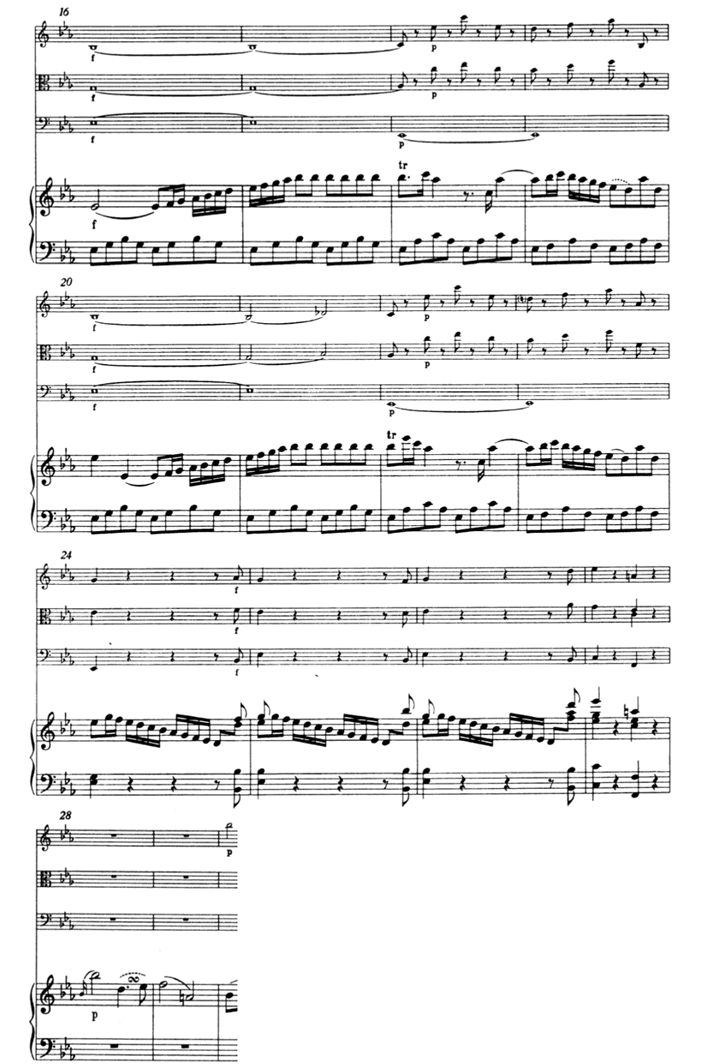
On the other hand, in several movements there is a short passage linking a K1-type closure in the main key to a new presentation in the secondary key, using, as an interim degree, the new key’s dominant. Consider, for instance, the opening movement of the Piano Quartet in E♭ major, K. 493 in Example G16 below: after a sizable K1-type cadential extension in mm. 16–24, a short modulating link mediates between the end of the primary theme and the onset of the secondary theme/thematic module in the dominant key on the downbeat of m. 28. Although the secondary-key dominant in the middle of m. 27—a dominant seventh chord on F—ostensibly fulfills the harmonic requirements of a K3-type closure, we do not annotate here a K3-type half cadence, because this sonority is approached still in the context of the primary key (a K3 closure is by definition attained already in the secondary key), and, besides, involves a voice-leading pattern and a metrical position that preclude construing it as a half cadence in the first place. On the other hand, the goal sonority of this transitional passage—the (contrapuntally deficient) arrival on B♭ at the beginning of m. 28—seems to assume a punctuational role, both as the cadential arrival of the preceding transitional passage and as the beginning of a new thematic presentation. A “K4” label is premature, because a K4-type cadence is supposed to conclude a passage already firmly rooted in the secondary key, whereas in the case at hand, m. 28 represents the first arrival at B♭ major in the movement. We opt for labeling this point—the beginning of m. 28—(as well as several other comparable cases) as a K2-type (elided) closure, as we construe it to represent a half-cadential arrival in the home key (in spite of the strong “authentic” leap F–B♭ in the implied bass part), at the same time serving as a point of departure of the secondary-theme zone. Importantly, labeling cadential arrivals that conclude such elided modulatory links as “K2” is only possible in movements in the major mode. In minor, the tonal goal of comparable modulatory links is the relative-major tonic, which is under no conditions construable as a K2-type closure, for which reason we leave them unannotated—cf., e.g., the first movement of the Symphony in G minor, K. 550 in Example G3: here, the modulatory passage in mm. 22–28 is elided with the beginning of a new theme in B♭ major, but this point of arrival isn’t construable as a K2-type half cadence, and is premature for a K4 label. (A similar constellation where no cadential labels are adequate in spite of a new section’s beginning occurs also in a small number of major-mode expositions that involve the beginning of the secondary-key area on the minor-mode dominant, which, due to the altered third, doesn’t qualify as a K2-type arrival—cf., e.g., Serenade for Wind Instruments K. 375, i, m. 38).
Example G16: W. A. Mozart, Piano Quartet in E♭ major, K. 493, i, mm. 16–30
K3-type cadences
The harmonic degree denoted by “K3” varies according to the movement’s mode: in major-mode movements of the repertoire under investigation, the degree in question is (invariably in Mozart) the dominant of the dominant key (V:V); in minor-mode movements, K3 denotes the dominant of the relative major key (III:V), with one notable exception (the opening movement of the String Quartet in D minor, K. 173, where the secondary key is the minor-mode key of the fifth degree, the K3-type cadence accordingly being v:V).
Half cadences in the secondary key often play a merely local (intra-thematic) role delineating the boundary between antecedent and consequent in period-like secondary themes—such cadences are disregarded in our annotations. Most typically, K3-type cadences take on the role of medial caesuras (cf. Hepokoski and Darcy, 2006, pp. 25ff.) directly preceding the onset of the secondary theme (see, e.g., Jupiter Symphony, i, mm. 49–58 in Example G4). However, not every K3-type cadence attained throughout the transition section materializes as a medial caesura: some half cadences are elided or embedded in ongoing transitional passages that, eventually, lead to a K4-type closure which, in turn, serves to introduce the secondary theme (see Sonata for Two Pianos, K. 448, i, mm. 25–33, Figure 1 and discussion in our main report). In analogy to elided/embedded K2-type cadences (discussed above), we take such cases into account in our annotations.
A complex, but not infrequent situation is that of a thematic presentation in the secondary-key area disrupted by the execution of a mid-thematic half cadence in this key. Inasmuch as the half cadence in question interrupts the passage it is embedded in (rather than serves as a local intra-thematic delimiter) and introduces new material subsequently, we include it in our labeling. Such a case occurs, for instance, in the overture to opera Idomeneo (see Example G17 below), where a secondary theme module in the minor dominant key (A minor), beginning at m. 45, arrives at a half cadence at m. 63, after which the music returns to the major mode (arguably, the following passage in mm. 64 has closing-theme characteristics, although no sufficient theme-concluding K4-type cadence has yet been established). In another well-known case in the first movement of the Jupiter Symphony, a K3-type half cadence at mm. 99–100 interrupts what seems to be a closing-group module (rather than a secondary theme as in the Idomeneo overture).
Example G17: W. A. Mozart, Idomeneo, re di Creta, K. 366, Overture, mm. 41–66 (piano reduction)
In a similar vein to K3-type cadences that introduce a thematic presentation, half cadences within the secondary-theme zone normally require to be approached via the raised fourth scale degree in order to act as interthematic (rather than intra-thematic) delimiters (consider, e.g., the augmented sixth chord in m. 62 of the Idomeneo overture in Example G17, used to approach the half-cadential degree in the following measure). Conversely, the lack of a raised fourth scale degree normally correlates with a merely local, intra-thematic function of the half cadence in question, as, for instance, in the first movement of the String Quartet in E♭ major K. 171, m. 35: here, although Mozart introduces new material subsequent to the half cadence, there is a strong sense of continuing the thematic presentation across the half-cadential event (which is accordingly disregarded in our corpus). However, in some cases we opt for labeling mid-thematic dominant arrivals that are not introduced via the raised fourth scale degree—this is, for instance, the case in the first movement of the String Quartet in A major, K. 169, m. 19: here, the half-cadential arrival is elided with what sounds like a distinct new beginning (mainly due to the sudden change of texture and dynamics).
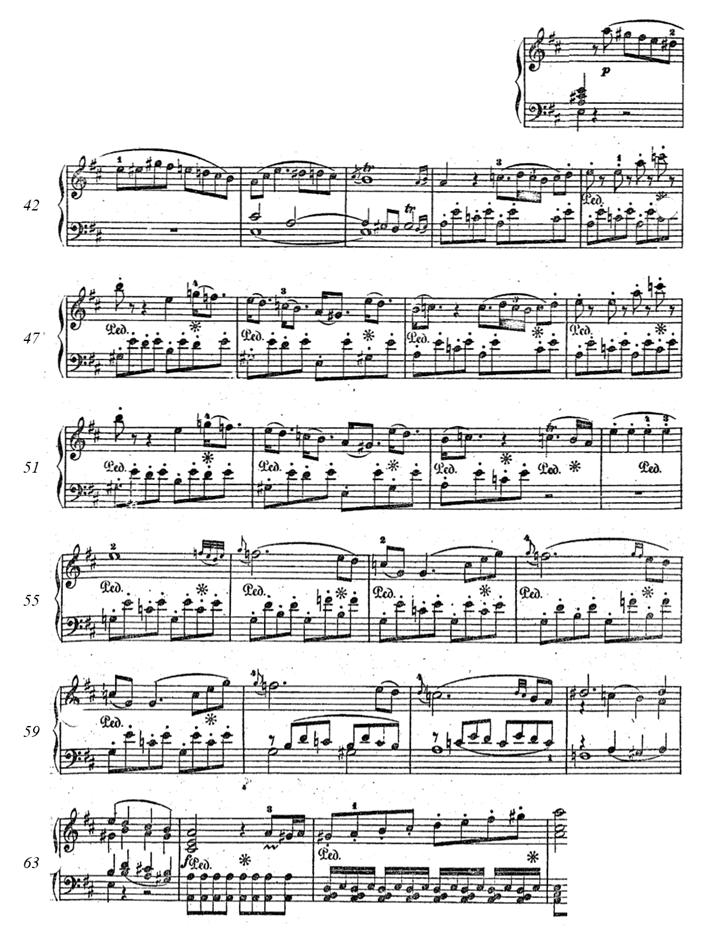
Similarly to the K2-type cadences in our corpus, many half cadences of the K3 type feature an augmented postcadential space (see also Table 2 in our main report). Most typically, the augmented postcadential space consists of several measures extending the half-cadential degree, followed by a short rest (caesura)—see, for instance, the first movement of the Clarinet Quintet K. 581, mm. 35–41 (Example G1). Often, the rest is followed by (sometimes: bridged by) a postcadential link directly connecting to the next unit’s beginning. In the finale of the G minor Symphony K. 183 (Example G7 above), there are two consecutive K3-type cadences, of which the first encompasses all three postcadential constituents—an extension (m. 24 through the downbeat of m. 26), a rest (on the second quarter note of m. 26), and a link (mid-measure 26 through the downbeat of m. 28)—whereas the second consists solely of a (polyphonic) postcadential link which is elided on one side with the cadential arrival at m. 37 and on the other with the next beginning at m. 41. The longest postcadential space in our corpus (17 measures in common time) is found in the first movement of the String Quintet in C major, K. 515, mm. 69–85: here, the K3-type postcadential extension transcends a mere reiteration of the closural degree—in fact, it spends several measures in D major, the dominant of the home-key dominant, thus creating an additional (though short-lived) tonal space on D in this exposition, besides those in the primary and secondary keys (C major and G major respectively). (In the case at hand, the postcadential extension is elided with a postcadential link on the downbeat of m. 82, thus skipping the optional interim rest, cf. Figure G1.) Regarding the possibility of a “half-cadential codetta” enhancing a K3-type closural event, we are particularly sensitive to the occurrence of the raised fourth scale degree in the aftermath of a K3-type cadence, construing it as a potential indicator that the passage in question may be construed as a postcadential extension—even in cases where it is acoustically separated from the preceding cadential arrival by a rest (see, e.g., Divertimento in B♭ major, K. 240, iv, mm. 32–48), or even appears to launch a new thematic module (cf. Piano Sonata in F major, K. 533, i, mm. 66–74).
There are relatively few elided K3-type cadences in the repertoire under analysis: only 20 in total, representing less than 10% of all 207 K3-type cadences is the dataset (cf., e.g., the number of elided K2-type half cadences which is 61, representing over 25% of their total amount in the corpus). This reflects the fact that many of the K3-type cadences annotated function as veritable theme-introducing caesuras, which are separated from the subsequent new beginning by a rest (sometimes bridged by a postcadential link). Of the (rather rare) elided K3-type cadences annotated in the corpus, most cases occur either at mid-transitional positions (as in the first movement of the Sonata for Two Pianos K. 448, where the postcadential extension of the K3-type arrival at m. 25 is indirectly elided with the remainder of the transition at m. 30, see Figure 1 in our main report), or at mid-thematic ones (as in the case of the first movement of the Violin Sonata in D major, K. 306 in Example G18 below, where what appears to be the beginning of the secondary theme in mm. 26ff. is punctuated at m. 38 by a K3-type half cadence which is, in turn, elided with the beginning of another thematic module). In only a few cases can the very onset of the secondary-theme zone be said to coincide with an elided K3-type cadence. However, such elided secondary themes—which accordingly begin on the dominant—are very different from more ordinary secondary themes that start with an alternation between the secondary-key dominant and tonic degrees (as, e.g., in the first movement of the F major Symphony K. 112, mm. 24ff.); rather, secondary themes that proceed from an elision with a K3-type half-cadential arrival begin with a long standing on the dominant which misleads to construe them as postcadential links, rather than thematic presentations in their own right (see discussion of the first movement of the Haffner Symphony below).
Example G18: W. A. Mozart, Violin Sonata in D major, K. 306, i, mm. 19–55
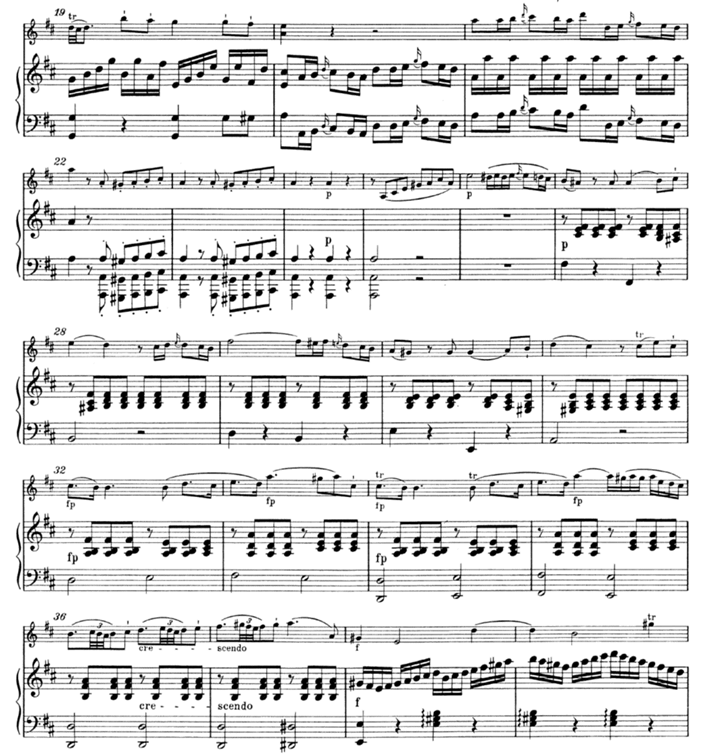
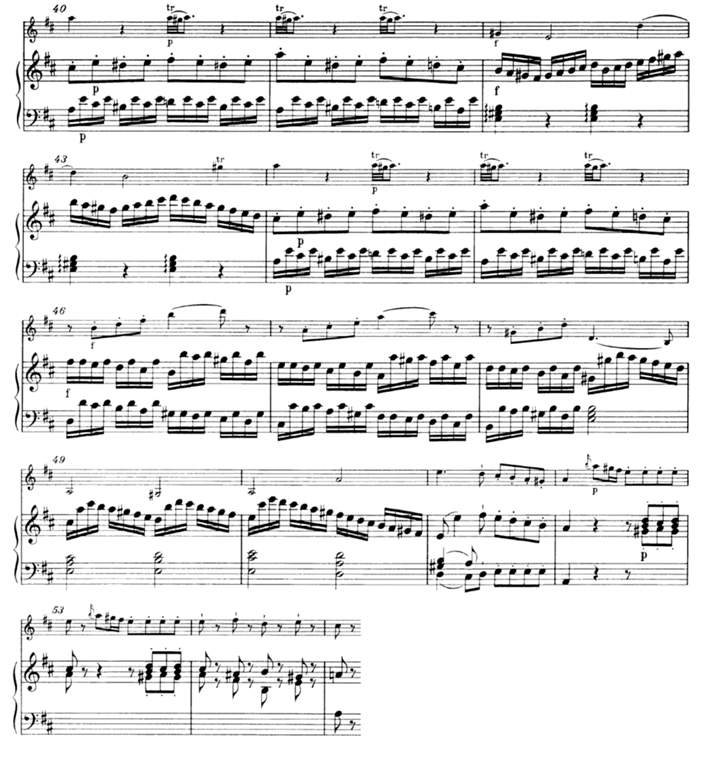
Postcadential links that follow K3-type cadences as a rule bridge the gap between the half-cadential dominant and a subsequent tonic degree. However, in addition to the usual type of postcadential links, often representing one-voice (or unison) melodic connectors (consider, e.g., K. 183, iv, mm. 26–28 in Example G7), we also construe as postcadential links certain polyphonic passages that misleadingly resemble “independent” music passages located between—rather than within—closural events. Consider, for instance, the following Example G19 from the finale of the Jupiter Symphony K. 551. Although located in the aftermath of a theme-introducing K3-type cadence (cadential arrival at m. 64 with postcadential extension through m. 73), the secondary-theme module in mm. 74ff. soon produces yet another—this time mid-thematic—half-cadential arrival at m. 86. We argue that it is problematic to identify the subsequent passage—proceeding from an elision with the half-cadential arrival at m. 86—as an independent one, despite its complex polyphony: granted that the sudden forte at m. 94 makes this latter measure sound like a new beginning, the interim passage in mm. 86–93 is reduced to prolonging a single harmonic degree (the secondary-key dominant). We consequently construe this passage as a postcadential link mediating between the arrival at m. 86 and the new beginning at m. 94 (note that it may not be construed as a postcadential extension, because an extension connects two sonorities that express the same harmonic degree, whereas mm. 86–93 mediate between the half-cadential dominant and a subsequent new beginning on the tonic.)
Example G19: W. A. Mozart, Jupiter Symphony in C major, K. 551, iv, mm. 72–99 (piano reduction)
Distinguishing between polyphonic postcadential links (such as K. 551/iv, mm. 86–93 in Example G19) on the one hand and elided new beginnings on the other is a subtle analytical endeavor. Consider, for instance, the following Example G20 from the first movement of the Haffner Symphony K. 385. Although the dominant pedal point in mm. 48–57 closely resembles the one in the Jupiter finale, mm. 86–93 (see Example G19 above), the fact that m. 58 is perceived as an upbeat to a subsequent new beginning at mm. 59ff. (as opposed to K. 551/iv, m. 94 which is itself perceived as a new beginning) shows the Haffner Symphony passage to be delineated via the tonic arrival at m. 85, and discredits interpreting it as a link. We accordingly construe this passage as a standalone one expressing the harmonic dyad V:V–V:I. The different readings inevitably engender different modes of annotation: whereas in K. 551/iv we opt for a single (non-elided) closure at m. 86, with a subsequent new beginning at m. 94, in the case of K. 385/i, on the other hand, we annotate two closural events: an elided K3-type one at m. 48, and a K4-type one at m. 58, which latter concludes the interim passage in mm. 48–58 . (Evidently, in the case of an elided passage starting on the dominant—such as the one in K. 385/i, mm. 48–58—can be shown to proceed beyond the earliest available tonic arrival, the K4 label will be accordingly postponed to a later position corresponding to the interim passage’s end. Consider the first movement of the Sonata for Two Pianos K. 448, mm. 30–33 in Figure 1 in our main report: here, the elided dominant on the downbeat of m. 30 is resolved to the tonic degree already on the following downbeat; however, the subsequent measures act as continuation, thus postponing the actual closure and the corresponding K4 label to m. 33. Another notable difference between K. 385/i, mm. 48–58 and K. 448/i, mm. 30–33 is that in the former case the passage’s departure dominant is directly elided with the half-cadential arrival at m. 48, whereas in the latter one a postcadential extension that re-establishes the arrival dominant using the raised fourth scale degree D♯ mediates between the point of cadential arrival in m. 25 and the beginning of the elided interim passage on the downbeat of m. 30, making this a case of indirect elision.)
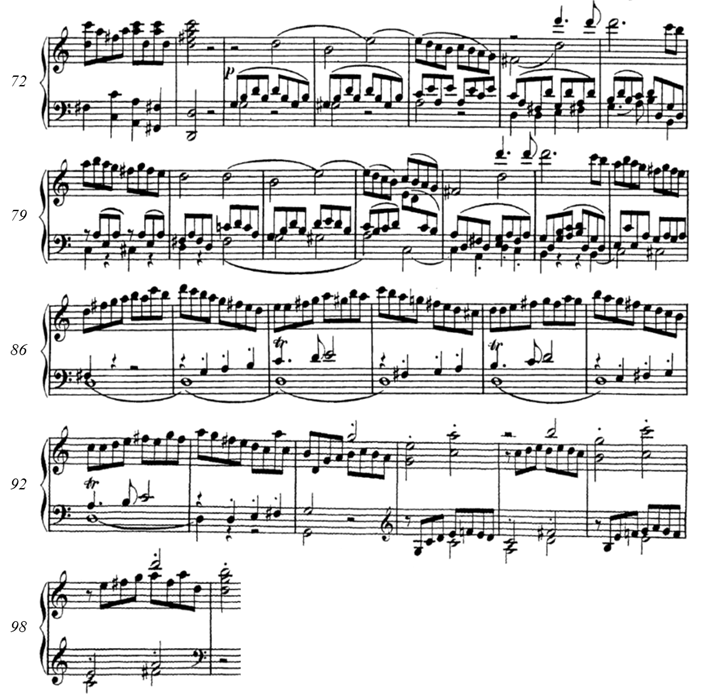
Example G20: W. A. Mozart, Haffner Symphony in D major, K. 385, i, mm. 41–75 (piano reduction)
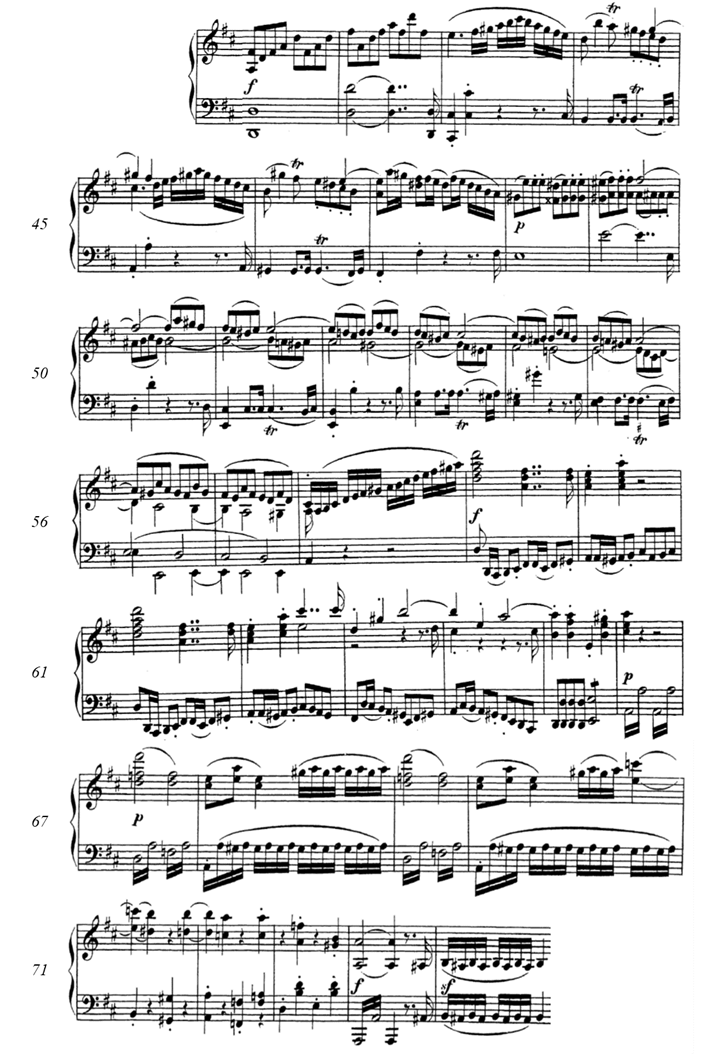
K4-type cadences
In Mozart’s major-mode sonata-allegro movements, “K4” invariably stands for the dominant key’s tonic; in minor-mode movements, the tonal goal of the exposition is the relative major tonic (III:I), with the sole exception of K. 173/i, a D minor movement featuring A minor (v:i) as its secondary-key goal. A K4-type cadence—as opposed to the other closure types—is absolutely mandatory, and occurs in every Classical sonata exposition at least once (cf. Table 2 in our main report). Notably, whereas interthematic cadences of the K1, K2, and K3 types mostly occur only once in a given exposition, the expositions under analysis reveal a multiplicity of K4 cadences to be the rule (totaling 702 occurrences, with an average of 2.4 K4-type cadences per movement). This appears to agree with Koch’s concept of an “appendix”—a passage in the secondary key that extends beyond and complements a previous passage that has already achieved sufficient closure on the secondary-key tonic (1782–1793, vol. 3, pp. 366ff.). In a similar vein, some modern sonata theories (e.g., Webster, 2001; Hepokoski and Darcy, 2006) acknowledge besides the secondary theme a “closing group” (or a “closing zone”) which may consist of several closing themes and codettas, all of which conclude on the secondary-key tonic.
In terms of modern sonata theories, K4-type cadences may occur at pre-secondary-theme, mid-secondary-theme, secondary-theme-concluding, and post-secondary-theme (or closing-zone) positions.
Pre-secondary-theme K4-type cadences as a rule conclude the transition section and are separated from the secondary theme itself by a short caesura (that may, however, be bridged by an upbeat figure—see, e.g., Dissonance Quartet K. 465, i, m. 71 in Example G5). Because they function as theme-introducing cadences, labeling such cadences as interthematic in our corpus does not depend on the degree of thematic completion attained at the point of closure (consider, e.g., the loosely knit, a-thematic passage in K. 448/i, mm. 30–33 that culminates in a pre-secondary-theme K4-type closure; see Figure 1 in our main report). In some cases of pre-secondary-theme cadences on the tonic of the dominant key (in major-mode expositions) there is doubt whether they should be more adequately labeled as half-cadential K2-type or as K4-type authentic cadences—in order to decide in such ambiguous constellations, we require that K4-type cadences must conclude sections that are—already from their beginning—firmly rooted in the secondary key (see above discussion of the K2-type closure in the second movement of the Violin Sonata in C major, K. 303, m. 24 and Example G13).
Whereas different modules in a (complex) secondary-theme zone may be separated by mid-secondary-theme K4-type cadences, there is arguably in every sonata exposition (at least) one K4-type cadence that qualifies for consideration as concluding the entire secondary theme (insofar as the secondary theme may be successfully delineated). Hepokoski and Darcy (2006, pp. 117ff.) pay special attention to locating a single cadential event marking the end of the secondary-theme zone, which they term “Essential Expositional Closure” to indicate its foremost structural role—however, their analytical endeavor is often confronted with considerable methodological difficulties in conjunction with expositions that feature complex secondary themes and multiple closural events. We argue that applying the concept of an “essential” closure to the corpus of Mozart’s sonata exposition under analysis is fundamentally problematic, as in many cases several thematic modules in the secondary-key area—each concluding with its own K4-type cadence—compete for the title of the “veritable” secondary theme, with each “candidate” supported by different structural aspects. (Consider, besides, the case of the Idomeneo overture in Example G17, where the thematic module that most convincingly resembles a secondary theme in mm. 45–63 concludes with a K3-type half cadence rather than on the secondary-key tonic.) Our annotation system avoids altogether the need to make a selection among the K4-type cadences featured in a given sonata exposition: by using a uniform “K4” label for all interthematic authentic cadences in the secondary-key area, we leave open whether a given cadence is located at the end of the secondary theme, or midway into it (or, indeed, at a transitional or a closing-group position). We argue that inasmuch as there are multiple thematic modules in the secondary-key area displaying a sufficient degree of thematic completion, using multiple K4 labels is justified—even in cases where such individual modules can be shown to combine to yield bigger thematic complexes.
Determining the degree of thematic closure in secondary-theme modules draws on the principles of thematic completion and repetition discussed above. As a rule, full-fledged sentential and period-like structures allow us to recognize a sufficient degree of thematic completion at the point of closure (unless some of the thematic elements are subsequently repeated, in which case the point of interthematic closure is postponed). There are, however, cases of “small” periods (usually spanning eight measures) that consist of non-complex antecedent and consequent, which raise the question of whether to interpret them as sufficiently complete thematic units by their own right or as continuation-demanding elements of a longer sentential presentation. In our annotations we give no uniform solution for such constellations; instead, we opt for basing our individual labeling decisions in every case on the perceived sense of closure at the end of the small period-like unit. Whereas, for instance, in the case of the secondary theme of the Dissonance Quartet’s first movement (see Example G5 above) we consider the elided cadence on the downbeat of m. 79 to conclude a sufficiently complete thematic module, in the first movement of the Divertimento for String Trio in E♭ major, K. 563 (see Example G21 below), on the other hand, we annotate no interthematic closure at m. 34. Note the subtle interplay between the structural aspects that strengthen and those that weaken each of these cadences: in the case of K. 465/i, the subsequent section proceeds with the previous triplet motive in a way suggestive of continuing the same thematic module; however, the elision and the sudden dynamic increase on the downbeat of m. 79 give a strong sense of a new beginning. On the other hand, the cadence in K. 563/i, m. 34, which is intrinsically a particularly weak one owing to the evaded cadential harmony, is nevertheless thematically speaking the stronger of the two due to the fact that the subsequent passage presents new thematic material. In the comparison at hand, intrinsic harmonic considerations seem to prevail over extrinsic contextual ones—however, this is by no means always the case across the annotated corpus.
Example G21: W. A. Mozart, Divertimento (String Trio) in E♭ major, K. 563, i, mm. 15–44
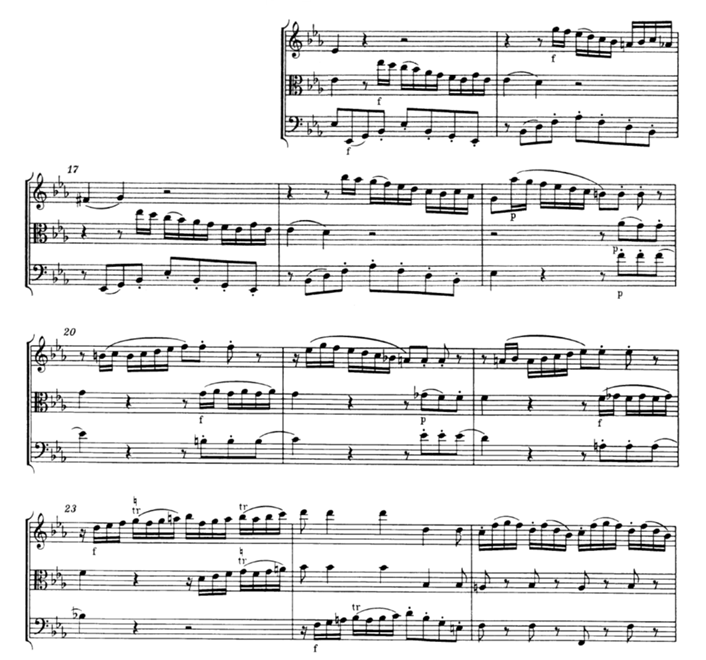
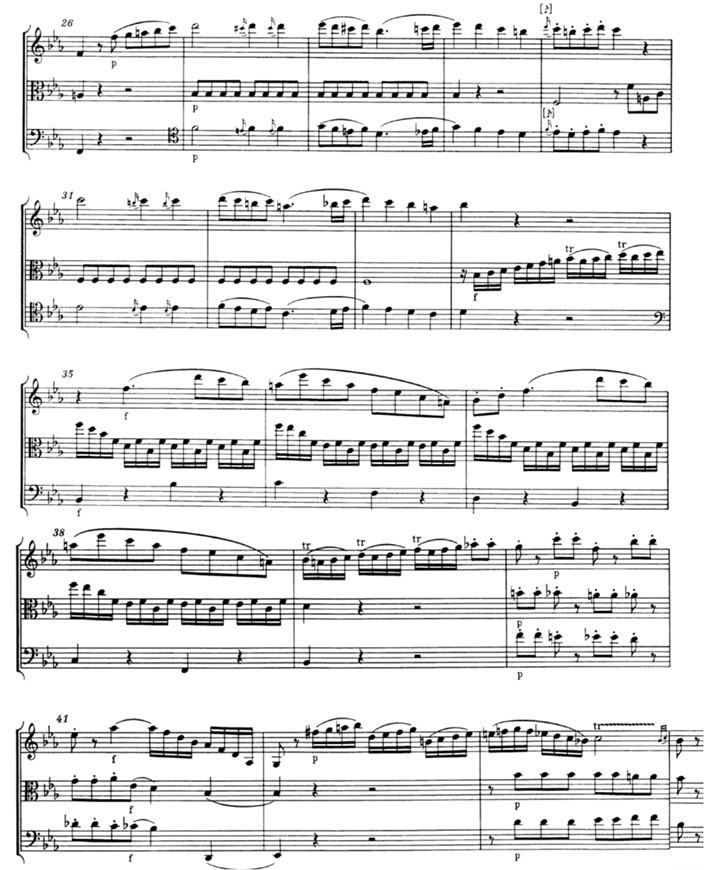
Identifying post-secondary-theme (closing-group) K4-type cadences requires to some extent different rules than those applied in the case of the other thematic zones. We argue that hearing a given passage in the secondary key as a closing theme (or a codetta)—as opposed to, say, the secondary theme “proper” – engenders a different mode of listening with regard to the expected degree of thematic completion. Serving to round off the exposition section, closing thematic material is not expected to possess a complete sentence or period design—accordingly, we annotate a K4-type cadence whenever a closing idea seems to come to an end, regardless of whether thematic completion of the kind postulated above with regard to the primary and secondary theme is attained or not. It follows that towards an exposition’s end, cadences annotated as “K4” tend to occur at comparatively short intervals and in multitude.
Due to the relatively limited degree of thematic completion expected of closing ideas, the above-formulated principle of subsuming codettas under preceding cadential events as postcadential extensions does not apply to closing-group elements. Although from a harmonic point of view many post-secondary-theme codettas may be construed as mere postcadential extensions, we treat them—as far as they represent individual thematic modules—as separate sections contributing each an additional cadential label to the corpus. Consider, for instance, the three final measures of the Sonata facile first movement’s exposition (Example G2, mm. 26–28): although the simple oscillation between tonic and dominant degrees suggests interpretation as a postcadential extension (see, e.g., our above discussion of K. 581/i, mm. 15–19, Example G1), this concise closing module nevertheless contributes a new thematic element (to be immediately re-invoked at the development section’s beginning) and appears to be self-sufficient enough—on a codetta’s terms—to justify two separate cadential labels at mm. 26 and 28. On the other hand, codas and codettas are described as spaces where “thematic liquidation” takes place (cf. Schoenberg, 1967, pp. 185f.). Insofar as the final section of a sonata exposition engages in breaking down a given thematic module into ever smaller fragments (rather than presenting a succession of different modules), we construe it as an ongoing codetta and annotate a single K4 label at its end (consider, for instance, the first movement of the Divertimento in B♭ major, K. 287, mm. 97–111).
Closing themes and codettas are, as a rule, delineated on both sides by K4-type cadences. Seldom, a codetta proceeds from an evaded cadence on the inverted secondary tonic. Consider, for instance, the first movement of Oboe Quartet in F major, K. 370, mm. 57–60: although this four-measure codetta begins on a sixth chord, we argue that annotating it as an independent closing-group module is more appropriate than construing it as a mere continuation of the preceding thematic module with which it is elided. On the other hand, codettas that proceed from other degrees than the secondary-key tonic are disregarded in our annotations. For instance, the new thematic module in the fourth movement of the String Quintet in D major, K. 593, mm. 80–92, which is elided with the preceding secondary theme via a fully diminished seventh chord, does not receive a separate beginning label: as we recognize no closural degree at the point of elision, this codetta is subsumed under the same space as the secondary theme.
Although we generally opt for construing separate closing-zone codettas as individual entities engendering multiple K4 annotations, we apply in the analysis of the closing zone the pedal-point principle which, as a rule, contributes toward reducing the number of annotated cadences (see discussion above). Very frequently, the exposition’s final measures feature a bass pedal point on the secondary-key tonic that stretches throughout an entire passage. While some of these passages are very short and devoid of thematic substance, some are considerably longer and may also include substantial references to previous thematic material (see, e.g., Sonata for Violin in G major, K. 301, i, mm. 80–84). In some rare cases, the local context suggests that the most substantial expositional closure occurs in the course of such a pedal-point passage (consider, e.g., the third movement of the Symphony in G major, K. Anh. 221 [45a], where the entire end of the exposition in mm. 33–43 is supported by a pedal point on D). However, to maintain a consistent annotation standard across the corpus we opt for a uniform treatment of pedal-point based passages at the exposition’s end, annotating them as a single, extended K4-type closural event. Along similar lines, chord breaking and unison figures that may be construed as connecting tones of the final tonic chord (see, e.g., Haffner Symphony K. 385, i, mm. 92–94) are considered as extending the previous passage and do not contribute additional closural labels.
4. Miscellaneous methodological guidelines and considerations
Exclusion of concerto movements from the annotated corpus. We opt for this omission owing to some cardinal structural differences between concerto movements in sonata form and non-concerto sonata movements (e.g., the doubling of passages and cadential events between the opening orchestral ritornello and the solo-exposition in concerto movements; the lack in concerto movements of a double bar to demarcate the exposition’s end; different, concerto-specific segmentation due to alternation between soloist and orchestra). This pertains not only to Mozart’s concertos for one or more instruments, but also to concerto-like movements in serenades and divertimenti (e.g., K. 203/iv, K. 204/iii). The fourth movement of the Cassation K. 100 and the Church Sonata in C major, K. 336 resemble only partly the structure of concerto movements; however, both movements begin with a short orchestral ritornello, engendering a different cadential structure from that of non-concerto movements—accordingly, we omit them as well.
Inclusion of sonata movements from Mozart’s works for the stage; works of doubtful authenticity. Eighteenth-century opera overtures share historical origin and crucial structural characteristics with the concert-hall symphony of the time. Moreover, Mozart himself employed and rearranged opera overtures as symphonies and vice versa. We accordingly include in our corpus sonata-allegro movements from among Mozart’s overtures and other works for the stage (in multi-section overtures, only the sonata-allegro portions are included). Table G1 below informs about the overtures that are not included in the corpus due to the fact that they exist in another concert-hall version which is, in turn, included. The overture to the ballet Les petits riens, K. Anh. 10 (299b) shares some characteristics with Mozart’s symphonic sonata-allegro movements; however, having a deviating tonal structure, we opt for omitting it from the corpus. Some of the works included in the corpus are of doubtful authenticity—some are accordingly published only in the supplement volumes of the Neue Mozart Ausgabe (1955–). For philological details regarding the choice of the analyzed repertoire and determining the date of composition included in the dataset, see Rom, 2011, pp. 709ff.
Table G1: Sonata-allegro movements from Mozart’s stage works that are not included in the corpus
Stage work & movement | Concert-hall version included in the corpus |
La finta semplice, K. 51 (46a): Sinfonia, 1st and 3rd section | Symphony in D major, K. 45: 1st and 4th movements |
Ascanio in Alba, K. 111: Overtura | Symphony in D major, K. - (111 [Overture and No. 1] and 120 [111a]): 1st movement |
Il sogno di Scipione, K. 126: [Overtura], 1st section | Symphony in D major, K. 161 (141a, 163): 1st movement |
La finta giardiniera/Die verstellte Gärtnerin, K. 196: Overtura | Symphony in D major K. - (196 [Overture] and 121 [207a]): 1st movement |
Il re pastore, K. 208: Overtura | Symphony in C major, K. - (208 [Overture, Aria No. 1] and 102 [213c]): 1st movement |
Expositional cadences vs. recapitulatory cadences. In most sonata movements by Mozart, the recapitulation section follows closely in the exposition’s footsteps—this also applies to the employment of interthematic cadences in the recapitulation. However, labeling recapitulatory cadences poses particular methodological challenges: for one thing, due to the tonal adjustment of the secondary-key area K2- and K3-type cadences in the recapitulation target identical harmonic degrees (the principal-key dominant), quite often creating ambiguous constellations. We accordingly opt for confining our corpus to expositional labels only; however, we suggest that further investigation into the recapitulatory counterparts of the interthematic cadences labeled in our corpus may yield insightful results.
Tempo and time signature fields specified in the dataset. For every movement, we specify only a single tempo indication and a single time signature, even where it has additional ones, as in the case of movements featuring a slow introduction. The values specified refer in all cases to the sonata-allegro portion of the movement.
Omission of “next key” specification with regard to exposition’s final cadence. As a rule, an exposition section may be followed by either a return to the movement’s beginning (if there is a repeat sign), and, thus, to the main key, or by moving on to the development section’s initial tonal region, which may be in a variety of keys. (If there is a retransition passage, the secondary key is abandoned already prior to the exposition’s nominal ending position.) As we conceive of the next tonal goal following the final closure as located beyond the exposition’s boundaries, we opt for suppressing this data in our annotations.
Annotation of elided cadences. Elision is considered in some sources to represent a strategy of evading a closure by aligning it with the following beginning. However, we do not consider elided theme-concluding cadences to represent deficient closural events per se (unless there is a concrete deviation from the obligatory cadential voice-leading paradigm), and accordingly do not generally apply the designation “evaded” to elided interthematic cadences. Elided cadences may be of all four label types (K1–K4). For a cadence to be annotated as elided, we require that the subsequent new beginning coincide either with the point of cadential arrival (occurring, most typically, on a downbeat) for a direct elision, or—if there is a postcadential extension involved—with the end of that extension for an indirect elision. The most straightforward case of elision occurs when the upper (“melodic”) voice is engaged in (new) melodic activity at the point of elision (see, e.g., elided K2-type cadence in K. 493/i, m. 28 in Example G16; elided K3-type cadence in K. 306/i, m. 38 in Example G18). We further opt for annotating elision if at the point of cadential arrival the onset of a new accompaniment figure/contrapuntal line (as, e.g., in K. 448/i, m. 17 in Figure 1; K. 366/overture, m. 45 in Example G17; K. Anh. 171 [285b]/i, m. 59), or of a new dynamic level (as in K. 465/i, m. 79 in Example G5; K. 550/iv, m. 101) makes it possible to construe the new segment’s beginning as coinciding with the cadential arrival (the mere onset of a pedal tone at the point of cadential arrival is, however, insufficient for establishing an elision—cf. K. 204/i, m. 29). If, on the other hand, there is a rest, or even a “virtual caesura” between the cadential arrival and the next melodic impulse (consider, e.g., K. 19/i, m. 44), we do not annotate an elision. In case there is no melodic elision and the accompaniment figure starts after the downbeat, the beginning of the new segment will as a rule be construed to occur at a mid-measure (or even off-beat) position, and no elision is considered to take place (cf. K. Anh. 171 [285b]/i, m. 16, where we construe the new beginning to occur on the measure’s second eighth note). However, if the new accompaniment figure serves as an upbeat, the new beginning will be deferred to the next downbeat (and, again, no elision is considered to take place—cf. K. 303/ii, m. 24 in Example G13). Similarly, if the melodic part (normally the upper part) has an upbeat figure beginning midway into the measure, no elision is considered to take place and the beginning of the next segment is considered to occur at the next downbeat (as, e.g., in K. 306/i, mm. 25–26 in Example G18), or at the next harmonized metrical position (consider, e.g., K. 306/i, m. 52/3, Example G18).
End of exposition past last closure. By definition, the end of a given exposition coincides with the end of the exposition’s final measure. Normally, this position also coincides with the end of the most recent K4-type cadential space. However, occasionally the exposition’s end occurs past the last expositional K4-type cadential event—in such cases, the tonal embedding of the remainder of the exposition is not recorded in our annotations. This often results from the presence of a retransition passage at the exposition’s end—a short passage modulating back to the home key and preparing the exposition’s repeat and (in most cases) the onset of the development in the principal key. The retransition’s beginning is often elided with the exposition’s final K4-type cadential arrival (or with the end of its postcadential space)—cf., e.g., the String Quartet in D minor, K. 421, where the second repeat exceptionally differs from the first, thus engendering a development’s beginning in a foreign key. Occasionally, we construe the development to begin in the middle of the exposition’s final measure in expositions without repeat sign (see, e.g., Symphony in D major, K. 19, i, m. 46), thus engendering a short time interval of less than a measure that is only nominally part of the expositional space.
REFERENCES
Aldwell, E., Schachter, C., & Cadwallader, A. (2011). Harmony and Voice Leading 4th ed. Beverly, MA: Wadsworth Publishing.
Burstein, P. (2010). “Mid-Section Cadences in Haydn's Sonata-Form Movements,” Studia Musicologica, 51(1/2), 91-107.
Burstein, P. (2014). “The Half Cadence and Other Such Slippery Events,” Music Theory Spectrum 36/2, 203–227.
Caplin, W. E. (1998). Classical Form: A Theory of Formal Functions for the Instrumental Music of Haydn, Mozart, and Beethoven, New York: Oxford University Press.
Caplin, W. E. (2004). The Classical Cadence: Conceptions and Misconceptions. Journal of the American Musicological Society, 57 (1), 51–117. doi: 10.1525/jams.2004.57.1.51
Duane, B. (2019). Melodic Patterns and Tonal Cadences: Bayesian Learning of Cadential Categories from Contrapuntal Information. Journal of New Music Research, 48(3), 197–216. doi: 10.1080/09298215.2019.1607396
Dahlhaus, C. (1975). Rhythmus im Großen. Melos/Neue Zeitschrift für Musik, 1, 439–441.
Gjerdingen, R. O. (2007). Music in the Galant Style. New York, Oxford University Press.
Hepokoski, J., & Darcy, W. (1997). The Medial Caesura and its Role in the Eighteenth-Century Sonata Exposition. Music Theory Spectrum, 19 (2), 115–54. doi: 10.2307/745751
Hepokoski, J., & Darcy, W. (2006). Elements of Sonata Theory: Norms, Types, and Deformations in the Late-Eighteenth-Century Sonata, New York: Oxford University Press.
Ito, J. P. (2014). Koch’s Metrical Theory and Mozart’s Music: a corpus study. Music Perception: An Interdisciplinary Journal, 31 (3), 205-222. doi: 10.1525/mp.2014.31.3.205
Kaiser, U. (2007). Die Notenbücher der Mozarts: als Grundlage der Analyse von W.A. Mozarts Kompositionen, 1761-1767, Kassel: Bärenreiter.
Koch, H. C. (1782–1793). Versuch einer Anleitung zur Composition, 3 vols., Leipzig: Bohme. Reprint, Hildesheim: Olms, 1969. Selections trans. Nancy Kovaleff Baker as Introductory Essay on Musical Composition, New Haven, CT: Yale University Press, 1983.
Kostka, S., Payne, D., & Almén, B. (2013). Tonal Harmony, with an Introduction to Twentieth-Century Music (7th ed.). New York, McGraw-Hill.
Kühn, C. (1987). Formenlehre der Musik. Kassel: Deutscher Taschenbuch.
Martin, N. J., & Pedneault-Deslauriers, J. (2015). The Mozartean Half Cadence. In M. Neuwirth & P. Bergé (Eds.), What Is a Cadence? Theoretical and Analytical Perspectives on Cadences in the Classical Repertoire (pp. 185–213). Leuven: Leuven University Press.
Mozart, W. A. (1955-). Neue Mozart Ausgabe=Neue Ausgabe sämtlicher Werke, Salzburg and Vienna, published by the International Foundation Mozarteum, Salzburg, 10 Series, Kassel: Bärenreiter.
Neuwirth, M. (2011). Re-investigating the Primary Theme Zone in Haydn’s Early Symphonies—Periods, Sentences, Loops, and Their Temporal Implications. In M. Eybl, M.-A. Dittrich, & R. Kapp (Eds.), Zyklus und Pexample G1:rozess: Joseph Haydn und die Zeit (pp. 237–274). Vienna: Böhlau.
Neuwirth, M. (2015). Fuggir la Cadenza, or the Art of Avoiding Cadential Closure: Physiognomy and Functions of Deceptive Cadences in the Classical Repertoire. In M. Neuwirth & P. Bergé (Eds.), What Is a Cadence? Theoretical and Analytical Perspectives on Cadences in the Classical Repertoire (pp. 117–156). Leuven, Leuven University Press.
Neuwirth M., & Bergé, P. (Eds.). (2015). What Is a Cadence? Theoretical and Analytical Perspectives on Cadences in the Classical Repertoire (pp. 117–156). Leuven, Leuven University Press.
Neuwirth, M., & Bergé, P. (2015). Introduction: What is a Cadence? Nine Perspectives. In M. Neuwirth & P. Bergé (Eds.), What Is a Cadence? Theoretical and Analytical Perspectives on Cadences in the Classical Repertoire (pp. 7–16). Leuven: Leuven University Press.
Neuwirth, M., Harasim, D., Moss, F. C., & Rohrmeier, M. (2018). The Annotated Beethoven Corpus (ABC): A Dataset of Harmonic Analyses of All Beethoven String Quartets. Frontiers in Digital Humanities, 5. https://doi.org/10.3389/fdigh.2018.00016
Hepokoski, J., & Darcy, W. (2006). Elements of Sonata Theory: Norms, Types, and Deformations in the Late-Eighteenth-Century Sonata, New York: Oxford University Press.
Ratz, Erwin (1973). Einführung in die musikalische Formenlehre: Über Formprinzipien in den Inventionen und Fugen J. S. Bachs und ihre Bedeutung für die Kompositionstechnik Beethovens, 3rd ed. Vienna: Universal, 1973.
Rohrmeier, M., & Neuwirth, M. (2015). Towards a Syntax of the Classical Cadence. In M. Neuwirth & P. Bergé (Eds.), What Is a Cadence? Theoretical and Analytical Perspectives on Cadences in the Classical Repertoire (pp. 285–336). Leuven, Leuven University Press. https://doi.org/10.2307/j.ctt14jxt45
Rom, U. (2011). Tonartbezogenes Denken in Mozarts Werken unter besonderer Berücksichtigung des Instrumentalwerks, Ph.D. Dissertation, retrieved from: http://opus4.kobv.de/opus4-tuberlin/frontdoor/index/index/docId/2988, accessed on Oct. 1, 2020.
Rosen, C. (1988). Sonata forms. New York: W.W. Norton.
Schoenberg, A. (1967). Fundamentals of Musical Composition, ed. G. Strang & L. Stein, London-Boston: Faber & Faber.
Temperley, D. (2004). The Cognition of Basic Musical Structures. Cambridge, MA, The MIT Press.
van Kranenburg, P., & Karsdorp, F. (2014). Cadence Detection in Western Traditional Stanzaic Songs using Melodic and Textual Features. In Proceedings of the 15th International Society for Music Information Retrieval Conference, Taipei (pp. 391–396).
Waldura, M. (2002). Periode oder tonale Sequenz: Überlegungen zur Struktur von Mozarts Themen. Mozart Studien, 11, 11–72.
Webster, J. (2001). Sonata form. Grove Music Online. Retrieved 9 May. 2020, from https://www.oxfordmusiconline.com/grovemusic/view/10.1093/gmo/9781561592630.001.0001/omo-9781561592630-e-0000026197. doi: 10.1093/gmo/9781561592630.article.26197
Winter, R. S. (1989). The Bifocal Close and the Evolution of the Viennese Classical Style. Journal of the American Musicological Society, 42, 275–337.