Depth
Last updated: 2026-03-29
Checks: 7 0
Knit directory: ~/Documents/GitHub/PAINT/
This reproducible R Markdown analysis was created with workflowr (version 1.7.2). The Checks tab describes the reproducibility checks that were applied when the results were created. The Past versions tab lists the development history.
Great! Since the R Markdown file has been committed to the Git repository, you know the exact version of the code that produced these results.
Great job! The global environment was empty. Objects defined in the global environment can affect the analysis in your R Markdown file in unknown ways. For reproduciblity it’s best to always run the code in an empty environment.
The command set.seed(20251106) was run prior to running
the code in the R Markdown file. Setting a seed ensures that any results
that rely on randomness, e.g. subsampling or permutations, are
reproducible.
Great job! Recording the operating system, R version, and package versions is critical for reproducibility.
Nice! There were no cached chunks for this analysis, so you can be confident that you successfully produced the results during this run.
Great job! Using relative paths to the files within your workflowr project makes it easier to run your code on other machines.
Great! You are using Git for version control. Tracking code development and connecting the code version to the results is critical for reproducibility.
The results in this page were generated with repository version aeed082. See the Past versions tab to see a history of the changes made to the R Markdown and HTML files.
Note that you need to be careful to ensure that all relevant files for
the analysis have been committed to Git prior to generating the results
(you can use wflow_publish or
wflow_git_commit). workflowr only checks the R Markdown
file, but you know if there are other scripts or data files that it
depends on. Below is the status of the Git repository when the results
were generated:
Ignored files:
    Ignored:    .RData
    Ignored:    .Rhistory
    Ignored:    .Rproj.user/
    Ignored:    analysis/.Rhistory
    Ignored:    analysis/.Rproj.user/
    Ignored:    data/modern_metadata.csv
    Ignored:    data/neo_uvi.csv
    Ignored:    data/pigmentation_snps.csv
    Ignored:    data/simons_metadata.csv
    Ignored:    data/simons_whole.csv
Note that any generated files, e.g. HTML, png, CSS, etc., are not included in this status report because it is ok for generated content to have uncommitted changes.
These are the previous versions of the repository in which changes were
made to the R Markdown (analysis/depth.Rmd) and HTML
(docs/depth.html) files. If you’ve configured a remote Git
repository (see ?wflow_git_remote), click on the hyperlinks
in the table below to view the files as they were in that past version.
| File | Version | Author | Date | Message |
|---|---|---|---|---|
| html | d44f320 | Lily Heald | 2026-03-29 | change theme |
| Rmd | 216fc6e | Lily Heald | 2026-03-27 | Update text |
| html | 552a0a3 | Lily Heald | 2026-03-26 | Build site. |
| html | 7394148 | Lily Heald | 2026-03-26 | Build site. |
| Rmd | 610f95c | Lily Heald | 2026-03-26 | wflow_publish("analysis/depth.Rmd") |
| html | bce46ce | Lily Heald | 2026-03-26 | Build site. |
| Rmd | b98a9f1 | Lily Heald | 2026-03-26 | wflow_publish("analysis/depth.Rmd") |
| Rmd | a713e79 | Lily Heald | 2026-03-26 | Create summary tables |
| html | a713e79 | Lily Heald | 2026-03-26 | Create summary tables |
| html | ce1571b | Lily Heald | 2026-03-26 | Build site. |
| html | 2d31b45 | Lily Heald | 2026-03-26 | Build site. |
| Rmd | 05c4750 | Lily Heald | 2026-03-26 | stack snp distribution |
| html | 05c4750 | Lily Heald | 2026-03-26 | stack snp distribution |
Sequencing coverage
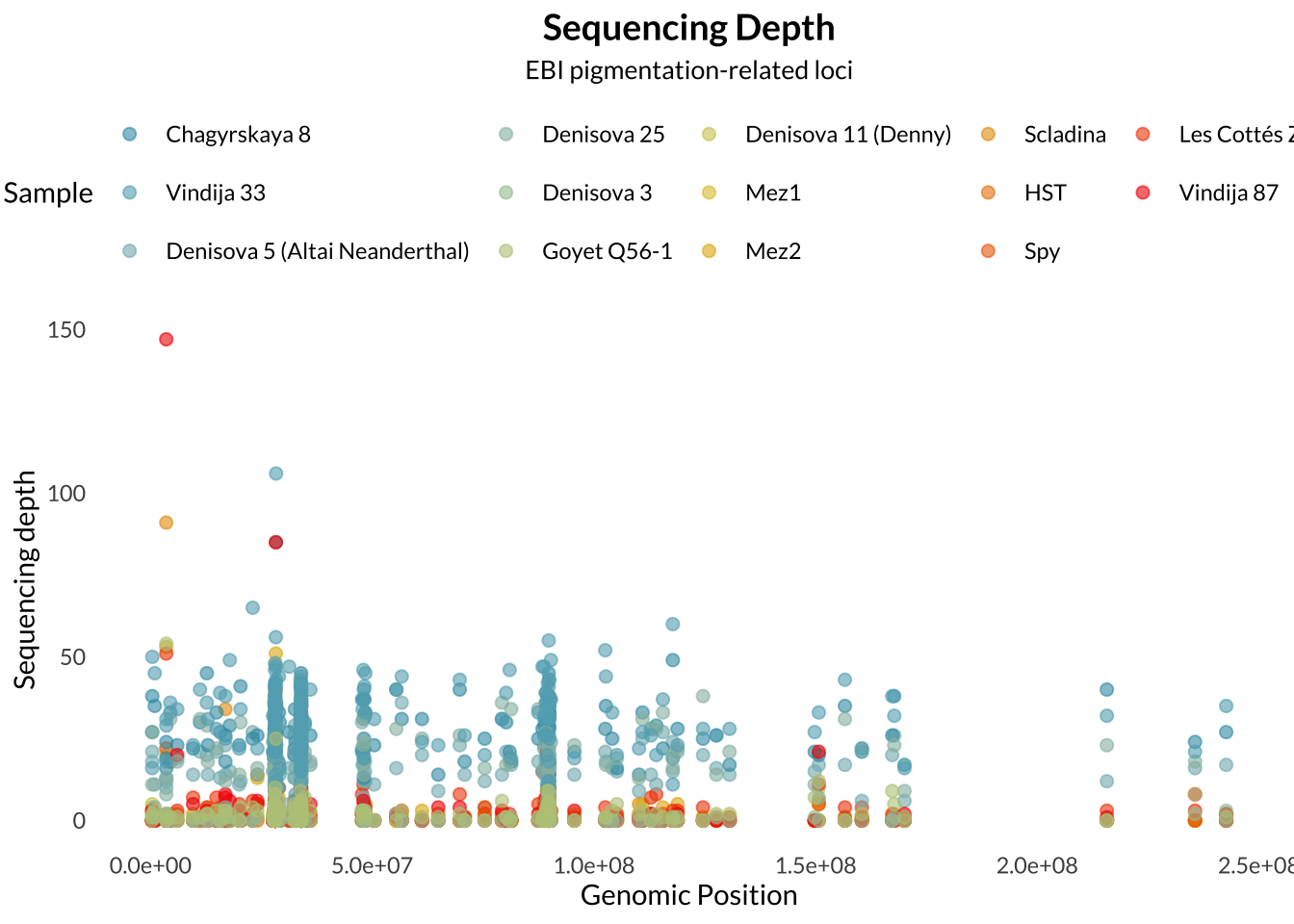
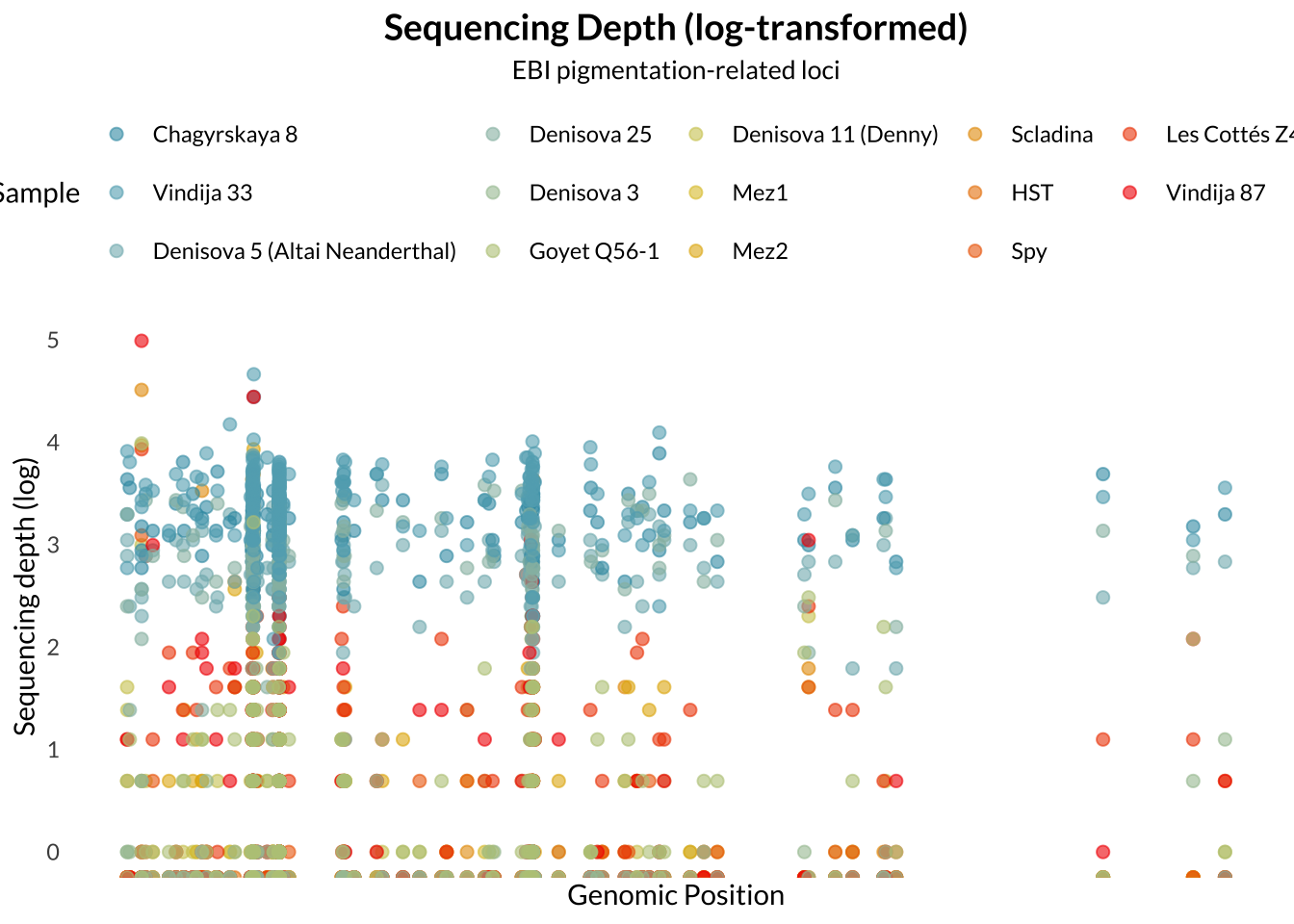
Sequencing read alignments were processed using samtools. The input BAM file was first indexed, then coordinate-sorted and re-indexed to ensure compatibility with downstream analyses. Read depth was calculated for archaic samples at the specified pigmentation-related SNP panel using samtools depth including sites with zero coverage.
Sequencing depth is an important measure in genotyping. Sequencing depth refers to the number of times a specific nucleotide was sequenced. A higher sequencing depth confers more confidence in the accuracy of the base calls, as it reduces the likelihood of technical errors in sequencing.
Missingness
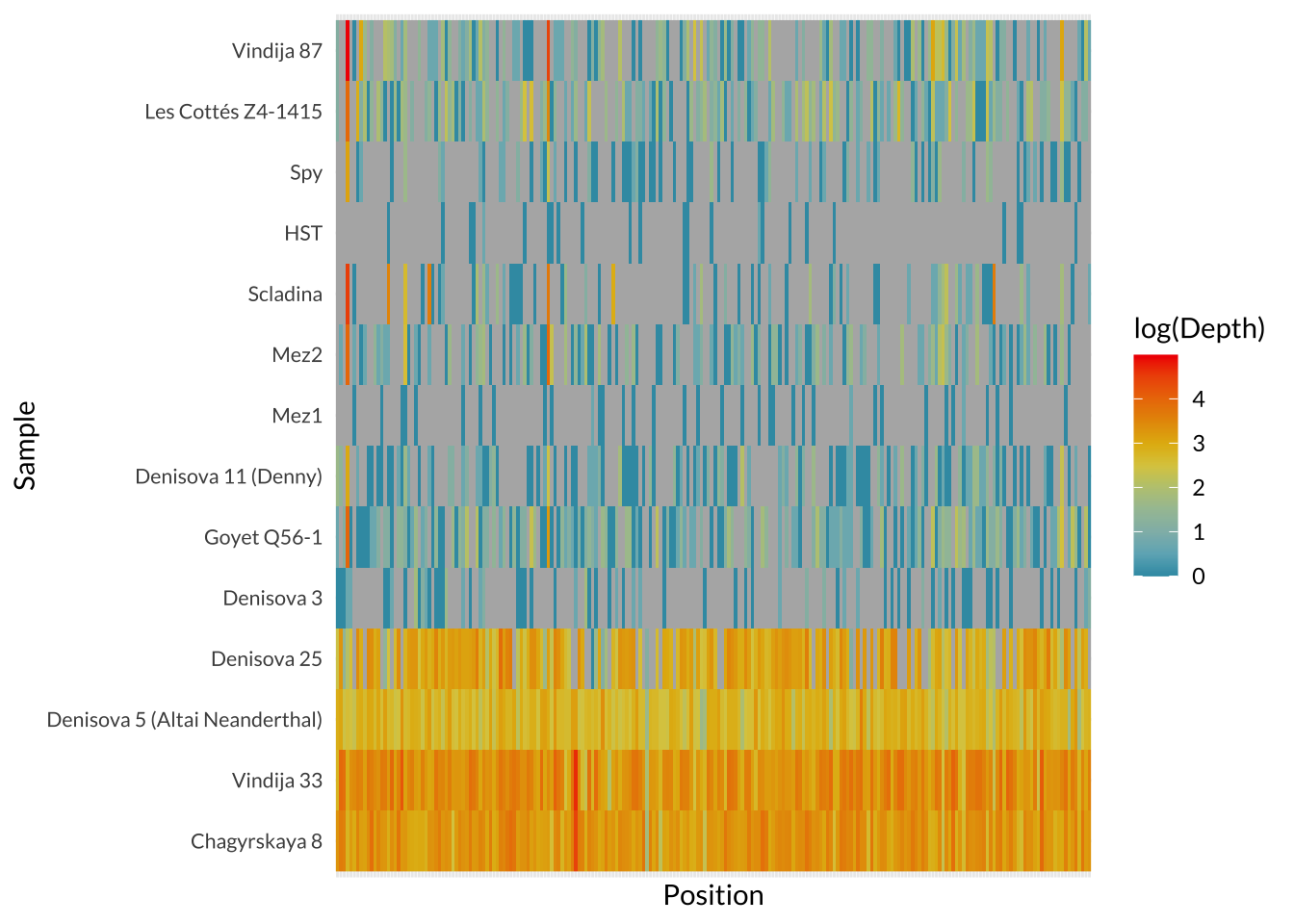
Several archaic genomes exist at low coverage, including the early Denisova 3 draft genome, the Denisova 11 (“Denny”) admixed individual, and later Neanderthals sequenced at ~1-2.7x coverage (Hajdinjak et al., 2018; Reich et al., 2010; Sawyer et al., 2015; Slon et al., 2018). These genomes are important for population history, but they are less reliable due to high levels of missingness and uncertainty. For that reason, the archaeological availability of high-coverage genomes limits phenotype inference. The high-coverage record includes only five individuals, ranging from 200-50ka, and a narrow geographic range.
Taken together, these genomes make direct archaic pigmentation analyses possible, but only in the manner of descriptions and comparisons. This limited dataset does not provide enough statistical power to make claims about the full pigmentation range of Neanderthals or Denisovans as groups. This motivates the aim of this study to provide a locus-level catalog of pigmentation-associated SNPs in available archaic genomes, and then compare those with variation in diverse modern humans. In order to examine patterns of missingness, I created a heatmap of where sequencing depth = 0.
sessionInfo()R version 4.4.2 (2024-10-31)
Platform: aarch64-apple-darwin20
Running under: macOS 26.3.1
Matrix products: default
BLAS: /Library/Frameworks/R.framework/Versions/4.4-arm64/Resources/lib/libRblas.0.dylib
LAPACK: /Library/Frameworks/R.framework/Versions/4.4-arm64/Resources/lib/libRlapack.dylib; LAPACK version 3.12.0
locale:
[1] en_US.UTF-8/en_US.UTF-8/en_US.UTF-8/C/en_US.UTF-8/en_US.UTF-8
time zone: America/Detroit
tzcode source: internal
attached base packages:
[1] stats graphics grDevices utils datasets methods base
other attached packages:
[1] wesanderson_0.3.7 showtext_0.9-7 showtextdb_3.0 sysfonts_0.8.9
[5] lubridate_1.9.4 forcats_1.0.1 stringr_1.6.0 dplyr_1.2.0
[9] purrr_1.2.1 readr_2.1.6 tidyr_1.3.2 tibble_3.3.1
[13] tidyverse_2.0.0 ggplot2_4.0.2 workflowr_1.7.2
loaded via a namespace (and not attached):
[1] sass_0.4.10 generics_0.1.4 stringi_1.8.7 hms_1.1.4
[5] digest_0.6.39 magrittr_2.0.4 timechange_0.4.0 evaluate_1.0.5
[9] grid_4.4.2 RColorBrewer_1.1-3 fastmap_1.2.0 rprojroot_2.1.1
[13] jsonlite_2.0.0 processx_3.8.6 whisker_0.4.1 ps_1.9.1
[17] promises_1.5.0 httr_1.4.7 scales_1.4.0 jquerylib_0.1.4
[21] cli_3.6.5 rlang_1.1.7 withr_3.0.2 cachem_1.1.0
[25] yaml_2.3.12 otel_0.2.0 tools_4.4.2 tzdb_0.5.0
[29] httpuv_1.6.16 curl_7.0.0 vctrs_0.7.1 R6_2.6.1
[33] lifecycle_1.0.5 git2r_0.36.2 fs_1.6.6 pkgconfig_2.0.3
[37] callr_3.7.6 pillar_1.11.1 bslib_0.10.0 later_1.4.5
[41] gtable_0.3.6 glue_1.8.0 Rcpp_1.1.1 xfun_0.56
[45] tidyselect_1.2.1 rstudioapi_0.18.0 knitr_1.51 farver_2.1.2
[49] htmltools_0.5.9 labeling_0.4.3 rmarkdown_2.30 compiler_4.4.2
[53] getPass_0.2-4 S7_0.2.1