Background
Last updated: 2023-06-23
Checks: 2 0
Knit directory: mecfs-dge-analysis/
This reproducible R Markdown analysis was created with workflowr (version 1.7.0). The Checks tab describes the reproducibility checks that were applied when the results were created. The Past versions tab lists the development history.
Great! Since the R Markdown file has been committed to the Git repository, you know the exact version of the code that produced these results.
Great! You are using Git for version control. Tracking code development and connecting the code version to the results is critical for reproducibility.
The results in this page were generated with repository version df39c69. See the Past versions tab to see a history of the changes made to the R Markdown and HTML files.
Note that you need to be careful to ensure that all relevant files for
the analysis have been committed to Git prior to generating the results
(you can use wflow_publish or
wflow_git_commit). workflowr only checks the R Markdown
file, but you know if there are other scripts or data files that it
depends on. Below is the status of the Git repository when the results
were generated:
Ignored files:
    Ignored:    .DS_Store
    Ignored:    .Rhistory
    Ignored:    .Rproj.user/
    Ignored:    output/batch-correction-limma/

Untracked files:
    Untracked:  data/7548-EW_RIN_7548-EW-1-12_WellTable.csv
    Untracked:  data/8289-EW_RIN_8289-EW-1__4__7_WellTable.csv
    Untracked:  data/8921-EW_MA_CHIP_1_Eukaryote_Total_RNA_Pico_8921-EW-1-7.pdf
    Untracked:  data/MECFS_RNAseq_metadata_CORRECTED.csv
    Untracked:  data/MECFS_RNAseq_metadata_CORRECTED.xlsx
    Untracked:  output/counts_vst.csv
    Untracked:  output/counts_vst_limma.csv
    Untracked:  output/res_aff_vs_unaff.csv
    Untracked:  output/res_aff_vs_unaff_df_genename_05.csv
    Untracked:  output/res_aff_vs_unaff_genename.csv

Unstaged changes:
    Modified:   code/copy_data.R
Note that any generated files, e.g. HTML, png, CSS, etc., are not included in this status report because it is ok for generated content to have uncommitted changes.
These are the previous versions of the repository in which changes were
made to the R Markdown (analysis/background.Rmd) and HTML
(docs/background.html) files. If you’ve configured a remote
Git repository (see ?wflow_git_remote), click on the
hyperlinks in the table below to view the files as they were in that
past version.
| File | Version | Author | Date | Message |
|---|---|---|---|---|
| Rmd | df39c69 | sdhutchins | 2023-06-23 | wflow_publish("analysis/") |
Abstract
Myalgic Encephalomyelitis/ Chronic Fatigue Syndrome (ME/CFS) is aseverely disabling, chronic illness that affects approximately 1-3 million Americans.ME/CFS can be briefly described as presenting with severe unrelenting fatigue,widespread unexplained pain, general malaise or feelings of illness described as flu-like,post-exertional malaise syndrome which is characterized by the drastic reduction inphysical and mental ability following exertion of any kind, GI and digestive problems,mental fogginess, and cardio-pulmonary abnormalities. The cause of ME/CFS is not wellunderstood. The majority of ME/CFS patients can recall a time of either sudden onset ofdysfunction from an illness or a gradual decline in function, and this most often occurs inadulthood. Many biological abnormalities have been identified in ME/CFS patients, suchas altered cytokine responses indicating increased systemic inflammation, alteredmetabolic profiling, dysregulation of the immune system, and neuro-inflammation.Despite a delay in initiation of genetic studies, there is now a growing body of knowledgeindicating an underlying genetic predisposition. Studies have shown that having a familymember with ME/CFS is one of the strongest predictive factors for the presence ofdisease; first-degree relatives of affected individuals were found to be three times morelikely to develop ME/CFS than controls. We hypothesized that ME/CFS is a geneticallyinherited disease that results in disrupted metabolic regulation of the immune system,thus resulting in an inappropriately activated immune system.
Methods
We performed WGS on 23 ME/CFS patients with 10 first degree relativehealthy controls. We utilized our custom WGS analysis software, Codicem, forinterpretation of the data. Our methods, which have been used to uncover the geneticcauses of disease in thousands of patients, support identification of all categories ofmolecular variation including genic and regulatory, protein-coding and non-proteincoding, small variants and larger structural variants (SVs, including more complex typesof rearrangements), chromosomal abnormalities, repeat expansions, mobile elementinsertions, and variants in regulatory regions that alter expression. In addition, we haveused a variety of existing tools to perform network analyses of candidate loci identified inME/CFS patients. We have extracted pharmacogenomics data from these patients which can be applied towards better choices in prescribed drugs. We have also collected RNA samples on 10 ME/CFS patients for expression analysis and immune repertoire sequencing.
Performing WGS Analysis
Performing Bulk RNASeq Analysis
We have collected RNA samples on 10 ME/CFS patients for expression analysis and performed bulk RNA sequencing via Vantage.
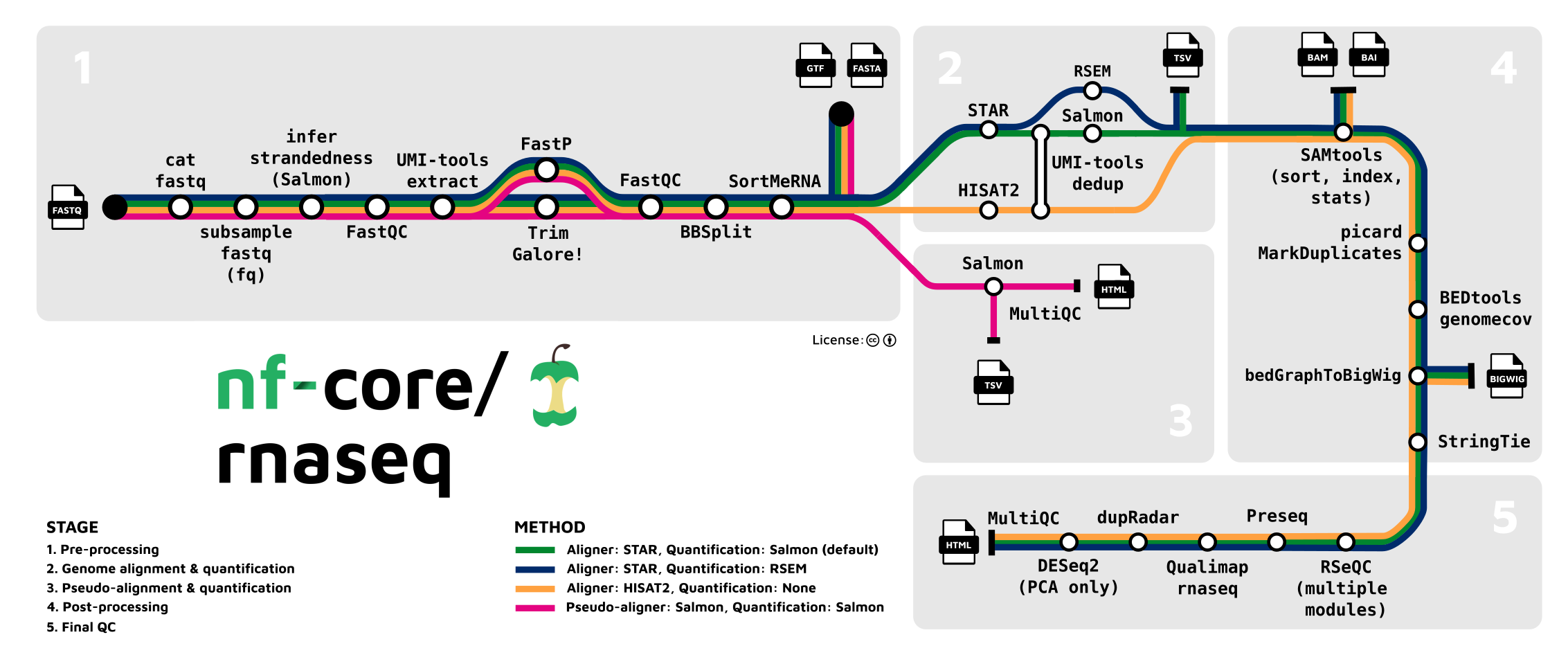
Our lab uses nf-core’s rnaseq pipeline which we’ve modified to work on the cluster, Cheaha, that we use.